Back

Simplifying Radical Expressions definitions

Control buttons has been changed to "navigation" mode.
1/15
  • Radical

    A mathematical symbol used to indicate roots, such as square roots or nth roots, often simplifying expressions.
  • Square Root

    A value that, when multiplied by itself, gives the original number; often simplified using rules for radicals.
  • Nth Root

    A value that, when raised to a specific power, results in the original number; generalizes the concept of square roots.
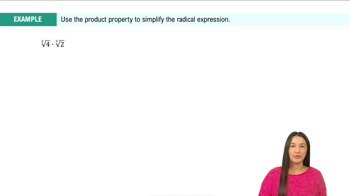
  • Product Rule

    A property allowing the multiplication of two radicals to be combined under a single radical with the same index.
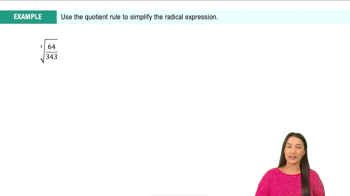
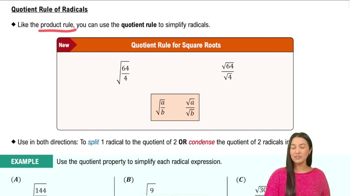
  • Quotient Rule

    A property enabling division within radicals to be split or condensed, simplifying expressions with the same index.
  • Perfect Square

    A number whose square root is an integer, often used to simplify radical expressions.
  • Index

    The small number above and to the left of the radical sign indicating which root is being taken.
  • Condensation

    The process of combining multiple radicals into a single radical using properties like the product or quotient rule.
  • Expansion

    The process of breaking a single radical into the product or quotient of two radicals with the same index.
  • Fraction

    A numerical expression representing division, often appearing under radicals and simplified using the quotient rule.
  • Integer

    A whole number, often the result of simplifying a radical containing a perfect square.
  • Factor

    A number that divides another number, used to rewrite radicands for easier simplification.
  • Radicand

    The value inside the radical symbol, which is subject to root extraction and simplification.
  • Simplification

    The process of reducing a radical expression to its most basic form using rules and properties.
  • Expression

    A mathematical phrase involving numbers, radicals, and operations, often simplified using radical rules.