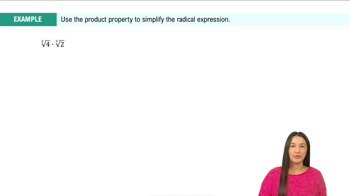
The product rule states that the square root of a times the square root of b equals the square root of a times b. This allows you to combine or split radicals with the same index.
How can you use the product rule to simplify √3 × √11?
You can combine them under one radical: √(3 × 11) = √33. Since 33 is not a perfect square, this is the simplified form.
What is the simplified form of √2 × √8 using the product rule?
Combine under one radical: √(2 × 8) = √16. Since 16 is a perfect square, the answer is 4.
How do you use the product rule in reverse to simplify √50?
Rewrite 50 as 25 × 2, then expand: √50 = √25 × √2 = 5√2. This uses the product rule in reverse to break down the radical.
When is a radical considered simplified?
A radical is simplified when the number under the radical cannot be broken down into a product containing a perfect square (other than 1). For example, √33 is already simplified.
Does the product rule apply only to square roots?
No, the product rule applies to all radicals of the same index, including cube roots, fourth roots, etc.
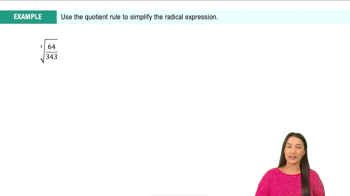
What does the quotient rule for radicals state?
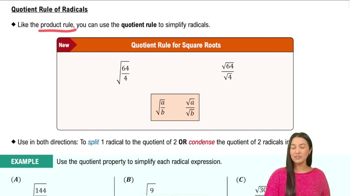
The quotient rule states that the square root of a divided by b equals the square root of a divided by the square root of b. This allows you to split or combine radicals involving division.
How can you use the quotient rule to simplify √144/25?
Split into two radicals: √144/25 = √144 / √25 = 12/5. Both 144 and 25 are perfect squares.
What is the simplified form of √9/49 using the quotient rule?
Split into two radicals: √9/49 = √9 / √49 = 3/7. Both 9 and 49 are perfect squares.
How do you use the quotient rule in reverse to simplify √300 / √3?
Combine under one radical: √300 / √3 = √(300/3) = √100 = 10. This uses the quotient rule in reverse.
Can the quotient rule be used in both directions?
Yes, you can use it to split one radical into two or to combine two radicals into one, depending on which form is easier to simplify.
Does the quotient rule apply only to square roots?
No, the quotient rule applies to all radicals of the same index, not just square roots.
What is the result of √64 ÷ √4 using the quotient rule?
√64 ÷ √4 = 8 ÷ 2 = 4. This matches the result of √(64/4) = √16 = 4.
Why might you want to expand a radical using the product or quotient rule?
Expanding a radical can help you identify and simplify perfect squares or cubes, making the expression easier to work with.
What is the general form of the product and quotient rules for nth roots?
For nth roots, the product rule is n√a × n√b = n√(a × b), and the quotient rule is n√(a/b) = n√a / n√b.