Skip to main content
Intermediate Algebra
My Course
Learn
Exam Prep
AI Tutor
Study Guides
Flashcards
Explore
Try the app
My Course
Learn
Exam Prep
AI Tutor
Study Guides
Flashcards
Explore
Try the app
Back
Systems of Linear Inequalities definitions
You can tap to flip the card.
System of Inequalities
You can tap to flip the card.
👆
System of Inequalities
A collection of two or more linear inequalities whose solution is the region where all shaded areas overlap.
Track progress
Control buttons has been changed to "navigation" mode.
1/15
Related flashcards
Related practice
Recommended videos
Systems of Linear Inequalities quiz
Systems of Linear Inequalities
15 Terms
Systems of Linear Inequalities
5. Systems of Linear Equations
5 problems
Topic
JustinRaimundo
Solving Systems of Linear Equations by Elimination
5. Systems of Linear Equations
5 problems
Topic
AllySteele
5. Systems of Linear Equations
3 topics
9 problems
Chapter
AllySteele
Guided course
06:26
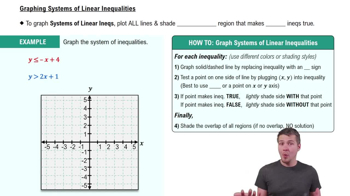
Graphing Systems of Linear Inequalities
185
views
6
rank
Guided course
06:50
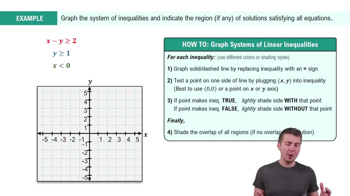
Graphing Systems of Linear Inequalities Example 1
133
views
2
rank
Terms in this set (15)
Hide definitions
System of Inequalities
A collection of two or more linear inequalities whose solution is the region where all shaded areas overlap.
Boundary Line
A straight line representing the edge of a linear inequality, drawn solid or dashed based on the inequality symbol.
Solid Line
A boundary drawn when the inequality includes equality, indicating points on the line are part of the solution.
Dashed Line
A boundary drawn when the inequality excludes equality, indicating points on the line are not part of the solution.
Slope-Intercept Form
An equation format y = mx + b, where m is slope and b is y-intercept, used for easy graphing of lines.
Y-Intercept
The point where a line crosses the y-axis, serving as a starting reference for graphing.
Slope
A measure of a line’s steepness, calculated as rise over run, guiding the direction of the graph.
Test Point
A coordinate, often (0,0), used to check which side of a boundary line satisfies the inequality.
Shaded Region
The area on a graph representing all solutions to a linear inequality, determined by test points.
Overlap
The intersection of shaded regions from multiple inequalities, indicating the solution to the system.
Solution Region
The combined area where all inequalities in a system are satisfied simultaneously.
Linear Inequality
An algebraic expression relating variables with inequality symbols, forming a boundary and solution region.
Greater Than Symbol
An inequality sign (>) indicating solutions lie above the boundary line, excluding the line itself.
Less Than or Equal Symbol
An inequality sign (≤) indicating solutions include the boundary line and the area below it.
No Solution
A scenario where shaded regions from all inequalities do not overlap, meaning no common solution exists.
 BackBack

 06:26
06:26