Back

The Product Rule quiz

Control buttons has been changed to "navigation" mode.
1/15
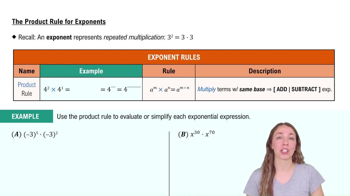
  • What does an exponent represent in an expression like 3^2?

    An exponent represents repeated multiplication of the base; 3^2 means 3 multiplied by itself twice.
  • What is the product rule for exponents?

    The product rule states that when multiplying two exponential expressions with the same base, you add their exponents.
  • How do you simplify 4^2 × 4^1 using the product rule?

    Add the exponents: 2 + 1 = 3, so 4^2 × 4^1 = 4^3.
  • What is the simplified form of -3^5 × -3^2?

    Add the exponents: 5 + 2 = 7, so -3^5 × -3^2 = -3^7.
  • What is the value of -3^7?

    The value of -3^7 is -2,871.
  • How do you simplify x^30 × x^70?

    Add the exponents: 30 + 70 = 100, so x^30 × x^70 = x^100.
  • What must be true about the bases to use the product rule?

    The bases must be the same in both exponential expressions.
  • What operation do you perform on the exponents when multiplying exponential expressions with the same base?

    You add the exponents together.
  • Why is the dot symbol used for multiplication instead of the x symbol?

    The dot is used to avoid confusion with the variable x, which is commonly used in algebra.
  • What is the simplest form of x^a × x^b?

    The simplest form is x^(a+b).
  • If you multiply 5^4 × 5^3, what is the result?

    Add the exponents: 4 + 3 = 7, so 5^4 × 5^3 = 5^7.
  • What is the product rule’s key step when simplifying expressions?

    The key step is to add the exponents of expressions with the same base.
  • How can you remember the product rule for exponents?

    Remember that multiplication and addition symbols are both crosses, so multiply bases and add exponents.
  • What happens if the bases are different when multiplying exponential expressions?

    The product rule does not apply; you cannot add the exponents if the bases are different.
  • Why is the product rule important in algebra?

    It helps simplify and manipulate expressions with exponents, which is essential for working with polynomials and other algebraic terms.