Back

The Quotient Rule definitions

Control buttons has been changed to "navigation" mode.
1/15
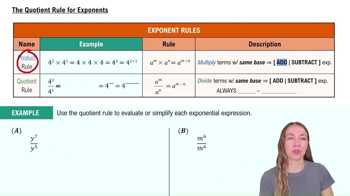
  • Quotient Rule

    A method for simplifying division of exponential expressions with identical bases by subtracting the exponents.
  • Exponent

    A value indicating how many times a base is multiplied by itself in an exponential expression.
  • Base

    The repeated factor in an exponential expression, remaining constant when applying exponent rules.
  • Zero Exponent Rule

    A principle stating any nonzero base raised to the zero power results in one.
  • Numerator

    The upper part of a fraction, representing the dividend in division of exponential expressions.
  • Denominator

    The lower part of a fraction, representing the divisor in division of exponential expressions.
  • Monomial

    An algebraic expression consisting of a single term, often involving exponents.
  • Polynomial

    An algebraic expression with multiple terms, each possibly containing exponents.
  • Standard Form

    A way of writing algebraic expressions with terms ordered by decreasing exponent values.
  • Simplification

    The process of reducing an expression to its most basic form using exponent rules.
  • Division

    An operation separating a quantity into equal parts, represented by a fraction bar in algebra.
  • Subtraction

    An operation used in the quotient rule to find the difference between exponents.
  • Product Rule

    A method for simplifying multiplication of exponential expressions with identical bases by adding exponents.
  • Expression

    A combination of numbers, variables, and operations, often including exponents in algebra.
  • Term

    A single part of an algebraic expression, which may include a variable raised to an exponent.