 Back
Factoring and Common Factors in Intermediate Algebra
Study Guide - Smart Notes
 Tailored notes based on your materials, expanded with key definitions, examples, and context.
Factoring & Common Factors
Greatest Common Factor and Factoring by Grouping
Factoring is a fundamental algebraic skill that involves expressing a polynomial as a product of its factors. The greatest common factor (GCF) is the largest expression that divides each term of a polynomial without a remainder. Factoring by grouping is a method used when a polynomial has four or more terms.
Greatest Common Factor (GCF): The largest factor shared by all terms in a polynomial.
Factoring by Grouping: Group terms with common factors, factor out the GCF from each group, then factor out the common binomial factor.
Example: Factor the expression .
Find the GCF:
Rewrite:
Example: Factor by grouping.
Group:
Factor each group:
Factor out :
Factoring Trinomials
Factoring trinomials of the form involves finding two numbers that multiply to and add to . This is a key skill for solving quadratic equations and simplifying expressions.
Identify and in .
Find two integers and such that and .
Rewrite as .
Example: Factor .
Find two numbers that multiply to $6: $1.
So,
Factoring with Negative Terms
When is negative in , find two numbers that multiply to $c$ and add to . One number will be positive and the other negative.
Example: Factor .
Find two numbers that multiply to and add to : and $2$.
So,
Factoring Quadratics with Leading Coefficient Not 1
For quadratics of the form , use the "ac method" or trial and error to factor.
Multiply and .
Find two numbers that multiply to and add to .
Rewrite the middle term using these numbers, then factor by grouping.
Example: Factor .
, , ,
Numbers: $6 (, )
Rewrite:
Group:
Factor:
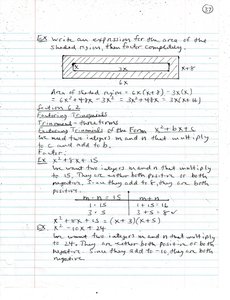
Application: Area of Shaded Region
Factoring can be used to solve geometric problems, such as finding the area of a shaded region by subtracting the area of one figure from another.
Example: Write an expression for the area of the shaded region, then factor completely.
Area of shaded region = Area of large rectangle - Area of small rectangle
Let the large rectangle have dimensions and , and the small rectangle have dimensions $x$ and $x$.
Area =
Factoring Special Forms
Some quadratics can be factored using special patterns, such as the difference of squares or perfect square trinomials.
Difference of Squares:
Perfect Square Trinomial:
Example: Factor .
Summary Table: Factoring Methods
Type of Polynomial | Factoring Method | Example |
|---|---|---|
Common Factor | Factor out GCF | |
Trinomial () | Find two numbers that multiply to and add to | |
Quadratic () | ac method, grouping | |
Difference of Squares |
Additional info: These notes cover essential factoring techniques for Intermediate Algebra, including factoring by grouping, trinomials, and special forms. Mastery of these methods is foundational for solving equations and simplifying expressions in algebra.
