 Back
BackIntermediate Algebra: Rational Expressions, Equations, and Variation
Study Guide - Smart Notes
 Tailored notes based on your materials, expanded with key definitions, examples, and context.
Rational Expressions and Functions
Introduction to Rational Functions and Equations
A rational function is a function of the form , where p(x) and q(x) are polynomials, and . The domain of a rational function consists of all real numbers except those that make the denominator zero.
Example:
Domain: Solve to find excluded values.
Evaluating Rational Functions: Substitute the given value into the function, ensuring the denominator is not zero.
Example:
Undefined: is undefined since denominator is zero.
Graphing Rational Functions
Rational functions often have vertical asymptotes where the denominator is zero and horizontal asymptotes determined by the degrees of numerator and denominator.
As approaches the value that makes the denominator zero from the left, may approach ; from the right, .
Vertical Asymptote: if and .
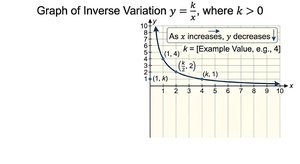
Application Example: For a train curve, gives the elevation needed for the outer rail. As increases, decreases, showing an inverse relationship.
Solving Rational Equations
A rational equation contains one or more rational expressions. To solve, multiply both sides by the least common denominator (LCD) to clear fractions, then solve the resulting equation.
Example:
Multiply both sides by , solve for .
Applications: Rational equations can model real-world problems, such as average waiting times or combined work rates.
Operations on Functions
Given functions and , and in their domains:
Addition:
Subtraction:
Multiplication:
Division: ,
Multiplication and Division of Rational Expressions
Simplifying Rational Expressions
To simplify, factor numerators and denominators, then cancel common factors.
Example:
Multiplying and Dividing Rational Expressions
Multiply numerators together and denominators together, then simplify.
To divide, multiply by the reciprocal of the divisor.
Example:
Applications
Rational expressions can model average cost, area, and other real-world quantities.
Addition and Subtraction of Rational Expressions
Finding the Least Common Multiple (LCM)
The LCM of two polynomials is the product of each factor the greatest number of times it occurs in either polynomial.
Example: LCM of and is .
Adding and Subtracting Rational Expressions
To add or subtract, first find the LCM of the denominators, rewrite each expression with the LCM, then combine numerators.
Example:
Applications
Combined resistance in parallel circuits is found using rational expressions:
Solving Rational Equations
Clearing Denominators
Multiply both sides by the LCD to eliminate denominators, then solve the resulting equation.
Example:
Multiply both sides by , solve for .
Applications
Work problems: If one pump empties a pool in 50 hours and another in 80 hours, together they take hours.
Mixture and distance problems can also be modeled with rational equations.
Complex Fractions
Simplifying Complex Fractions
A complex fraction has fractions in its numerator, denominator, or both. Simplify by finding a common denominator or multiplying numerator and denominator by the LCD.
Example:
Modeling with Proportions and Variation
Direct Proportion
Quantities and are in direct proportion if , where is the constant of proportionality. The graph is a straight line through the origin.
Example: If when , then and .
Inverse Variation
Quantities and are in inverse proportion if , where is a constant. As $x$ increases, $y$ decreases.
Example: If when , then and .
Joint Variation
When a variable varies directly as the product of two or more variables and/or inversely as another, it is called joint variation.
Example:
Applications
Stopping distance, volume of trees, and other physical phenomena can be modeled using direct, inverse, or joint variation.
Division of Polynomials
Dividing a Polynomial by a Monomial
Divide each term of the polynomial by the monomial.
Example:
Long Division of Polynomials
Divide the leading term of the dividend by the leading term of the divisor, multiply, subtract, and repeat until the degree of the remainder is less than the divisor.
Example: yields quotient .
References: Intermediate Algebra with Applications and Visualizations, Rockswold/Krieger/Rockswold, Pearson.
