 Back
Multiplication of Polynomials: Methods, Rules, and Applications
Study Guide - Smart Notes
 Tailored notes based on your materials, expanded with key definitions, examples, and context.
Multiplication of Polynomials
Multiplying Monomials
Multiplying monomials involves combining coefficients and applying exponent rules to variables. The process uses the commutative and associative laws to simplify expressions.
Coefficient Multiplication: Multiply the numerical coefficients.
Variable Multiplication: Add exponents for like bases using the rule .
Example:
Multiplying Monomials and Polynomials
When multiplying a monomial by a polynomial, use the distributive law to multiply the monomial by each term in the polynomial.
Distributive Law:
Example:
Multiplying Any Two Polynomials
To multiply two polynomials, apply the distributive law so that each term in one polynomial multiplies every term in the other. Combine like terms to simplify.
Distributive Law:
Example:
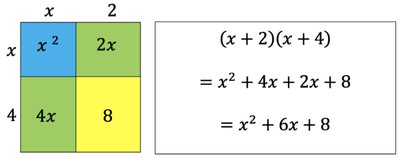
Multiplying Binomials: Area (Box) Method
The area (box) method visually organizes the multiplication of two binomials by creating a grid. Each cell represents the product of corresponding terms.
Box Method: Each box contains the product of a row and column term.
Example: produces , , , and $8x^2 + 6x + 8$.
Multiplying Binomials: FOIL Method
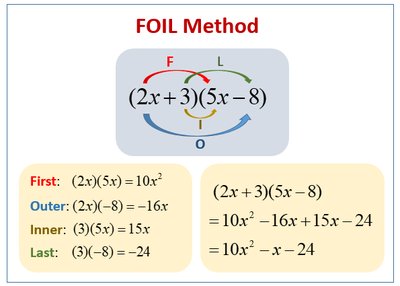
The FOIL method is a mnemonic for multiplying two binomials: First, Outside, Inside, Last. Each pair of terms is multiplied and then combined.
FOIL:
Example: First: Outer: Inner: Last: Combine:
Squares of Binomials
Squaring a binomial produces a trinomial called a perfect square. Expand using distributive law or FOIL.
Rule:
Rule:
Example:
Example:
Products of Sums and Differences (Difference of Squares)
Multiplying the sum and difference of the same two terms results in a difference of squares.
Rule:
Example:
Example:
Function Notation and Operations
Functions can be combined using addition, subtraction, and multiplication. The result is a new function.
Addition:
Subtraction:
Multiplication:
Example: If and :
Summary Table: Multiplication Rules for Polynomials
Type | Rule | Example |
|---|---|---|
Monomials | Multiply coefficients and add exponents | |
Monomial & Polynomial | Distributive law | |
Two Polynomials | Distributive law, combine like terms | |
Two Binomials (FOIL/Box) | FOIL or box method | |
Square of Binomial | ||
Sum & Difference |
Things to Remember and Mistakes to Avoid
Always combine like terms after multiplying.
Apply exponent rules correctly when multiplying variables.
Use distributive law for all polynomial multiplications.
Check for perfect squares and differences of squares patterns.
