 Back
Polynomials, Polynomial Functions, and Factoring: Study Notes for Intermediate Algebra
Study Guide - Smart Notes
 Tailored notes based on your materials, expanded with key definitions, examples, and context.
Polynomials, Polynomial Functions, and Factoring
Introduction to Polynomials and Polynomial Functions
This section introduces the fundamental concepts of polynomials and their functions, which are essential in Intermediate Algebra. Understanding the vocabulary, structure, and operations of polynomials is crucial for solving algebraic problems and modeling real-world situations.
Polynomial: A polynomial is a single term or the sum of two or more terms containing variables with whole number exponents. For example, is a polynomial.
Standard Form: Polynomials are usually written in order of descending powers of the variable, known as the standard form.
Term: Each part of a polynomial separated by a plus or minus sign is called a term.
Coefficient: The numerical factor of a term is called its coefficient.
Degree: The degree of a term is if $n$ is a whole number. The degree of a nonzero constant is 0. The constant 0 has no defined degree.
Leading Term and Leading Coefficient: The term with the highest degree is the leading term, and its coefficient is the leading coefficient.
Polynomials in Two Variables: A polynomial in two variables, and , contains terms of the form . The degree of such a term is .
Example: Using the Vocabulary of Polynomials
Given the polynomial , the degree is 9, the leading term is , and the leading coefficient is 8.
Polynomial Functions
A polynomial function is a function defined by a polynomial expression. To evaluate a polynomial function, substitute the given value for the variable and compute the result.
Example: If , then .
Smooth, Continuous Graphs
Polynomial functions of degree 2 or higher have graphs that are smooth and continuous. This means:
Smooth: The graph contains only rounded corners, with no sharp corners.
Continuous: The graph has no breaks and can be drawn without lifting the pencil from the coordinate system.
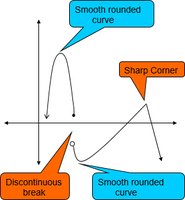
The graph above illustrates that a polynomial function must not have sharp corners or breaks. The presence of either disqualifies a graph from representing a polynomial function.
The Leading Coefficient Test
The Leading Coefficient Test helps determine the end behavior of the graph of a polynomial function based on its degree and leading coefficient:
If the degree is even and the leading coefficient is positive, the graph rises to the left and right.
If the degree is even and the leading coefficient is negative, the graph falls to the left and right.
If the degree is odd and the leading coefficient is positive, the graph falls to the left and rises to the right.
If the degree is odd and the leading coefficient is negative, the graph rises to the left and falls to the right.
Example: Using the Leading Coefficient Test
For , the leading coefficient is positive and the degree is even, so the graph rises to both sides.
For , the leading coefficient is negative and the degree is odd, so the graph rises to the left and falls to the right.
Application Example
If a polynomial function models the ratio of students to computers in schools, and the leading coefficient is negative, the graph will eventually fall below zero, which is not realistic for this context.
Adding Polynomials
To add polynomials, remove any parentheses and combine like terms:
Example:
Polynomials can also be added by arranging like terms in columns and combining them column by column.
Subtracting Polynomials
To subtract polynomials, change the sign of every term in the second polynomial and add the result to the first polynomial:
Example:
Summary Table: Key Properties of Polynomials
Property | Description |
|---|---|
Degree | Highest exponent of the variable |
Leading Term | Term with the highest degree |
Leading Coefficient | Coefficient of the leading term |
Standard Form | Terms arranged in descending order of degree |
Polynomial Function | Function defined by a polynomial expression |

Additional info: The textbook cover is included for context, as it is directly relevant to the course and chapter being studied.
