 Back
Section 5.1: Properties of Exponents and Introduction to Polynomials
Study Guide - Smart Notes
 Tailored notes based on your materials, expanded with key definitions, examples, and context.
Polynomials: Definitions and Classification
Identifying Terms and Types of Polynomials
Polynomials are algebraic expressions consisting of terms that are products of constants and variables raised to whole number exponents. The classification of polynomials depends on the number of terms they contain.
Monomial: A polynomial with one term.
Binomial: A polynomial with two terms.
Trinomial: A polynomial with three terms.
No Special Name: Polynomials with more than three terms do not have a special classification.
Example: The polynomial has three terms: , , and $10$.
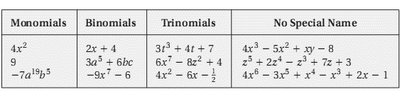
Practice: Counting and Listing Terms
To determine the number of terms in a polynomial, count each distinct product or constant separated by addition or subtraction.
: 2 terms (, )
: 3 terms (, , )
: 4 terms (, , , )
Degrees and Coefficients in Polynomials
Understanding Degree and Coefficient
Each term in a polynomial has a degree and a coefficient:
Coefficient: The constant factor multiplying the variable(s).
Degree: The sum of the exponents of the variables in the term.
Leading Term: The term with the highest degree.
Leading Coefficient: The coefficient of the leading term.
Example: For :
Terms: , , ,
Coefficients: 7-2$, $-1$
Degrees: $5, $1
Leading term:
Leading coefficient:
Degree of the polynomial: $5$
Arranging Terms in Polynomials
Descending and Ascending Order
Polynomials are often arranged by the degree of their terms:
Descending Order: Exponents decrease from left to right.
Ascending Order: Exponents increase from left to right.
Example: in descending order is .
Polynomial Functions
Classification by Degree
Polynomial functions are classified according to their degree, which is the highest exponent of the variable in the function.
Linear: Degree 1
Quadratic: Degree 2
Cubic: Degree 3
Quartic: Degree 4
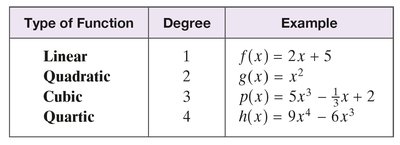
Example: is a cubic polynomial function.
Evaluating Polynomial Functions
Substituting Values
To evaluate a polynomial function for a given input, substitute the value into the function and simplify.
Example: For ,
Adding and Subtracting Polynomials
Combining Like Terms
To add or subtract polynomials, combine like terms—terms with the same variable(s) and exponent(s).
Add: Combine like terms: , , , Result:
Subtract: Change signs: Combine:
Summary and Key Points
Classification: Monomial (1 term), Binomial (2 terms), Trinomial (3 terms), No special name (4+ terms).
Degree: Number of variable factors in the term; the highest degree is the degree of the polynomial.
Coefficient: Constant factor in each term.
Order: Arrange terms in descending or ascending order by degree.
Polynomial Functions: Classified by degree: linear, quadratic, cubic, quartic.
Operations: Add/subtract by combining like terms after removing parentheses.
