 Back
Simplifying Complex Fractions in Intermediate Algebra
Study Guide - Smart Notes
 Tailored notes based on your materials, expanded with key definitions, examples, and context.
Complex Fractions
Definition and Structure
A complex fraction is a fraction in which the numerator, the denominator, or both, contain one or more fractions themselves. Understanding the structure of complex fractions is essential for simplifying them effectively.
Numerator: The top part of the complex fraction, which may itself be a fraction or contain fractions.
Denominator: The bottom part of the complex fraction, which may also be a fraction or contain fractions.
Main Fraction Bar: Separates the numerator and denominator of the complex fraction.
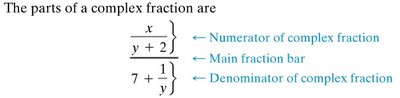
Examples of Complex Fractions:
Methods for Simplifying Complex Fractions
Method 1: Combine Like Terms and Divide
This method involves simplifying the numerator and denominator separately, then dividing the resulting fractions.
Add or subtract the fractions in both the numerator and denominator to obtain single fractions.
Invert the denominator and multiply the numerator by it (multiply by the reciprocal).
Simplify further if possible.
Example: Simplify
Step 1: The numerator is , the denominator is .
Step 2: Invert the denominator and multiply:
Step 3: Simplify:
Method 2: Multiply by the Least Common Denominator (LCD)
This method uses the LCD of all denominators in the complex fraction to clear fractions.
Find the LCD of all denominators appearing in the complex fraction.
Multiply both the numerator and denominator of the complex fraction by the LCD.
Simplify further if possible.
Example: Simplify
Step 1: LCD is
Step 2: Multiply numerator and denominator by LCD:
Numerator:
Denominator:
Step 3: Simplified fraction:
Practice Exercises
Try simplifying the following complex fractions using either method:
Key Points and Tips
Always simplify the numerator and denominator separately before combining.
Multiplying by the LCD is often the fastest way to clear fractions.
Check for opportunities to factor and reduce expressions after combining.
Be careful with negative exponents; rewrite them as reciprocals before simplifying.
Summary Table: Methods for Simplifying Complex Fractions
Method | Steps | When to Use |
|---|---|---|
Combine Like Terms | 1. Simplify numerator and denominator 2. Invert denominator and multiply 3. Simplify | When fractions are easily combined |
Multiply by LCD | 1. Find LCD 2. Multiply numerator and denominator by LCD 3. Simplify | When multiple denominators are present |
Additional info: Negative exponents in exercises indicate reciprocals, e.g., .
