 Back
BackSolving Compound Inequalities in Intermediate Algebra
Study Guide - Smart Notes
 Tailored notes based on your materials, expanded with key definitions, examples, and context.
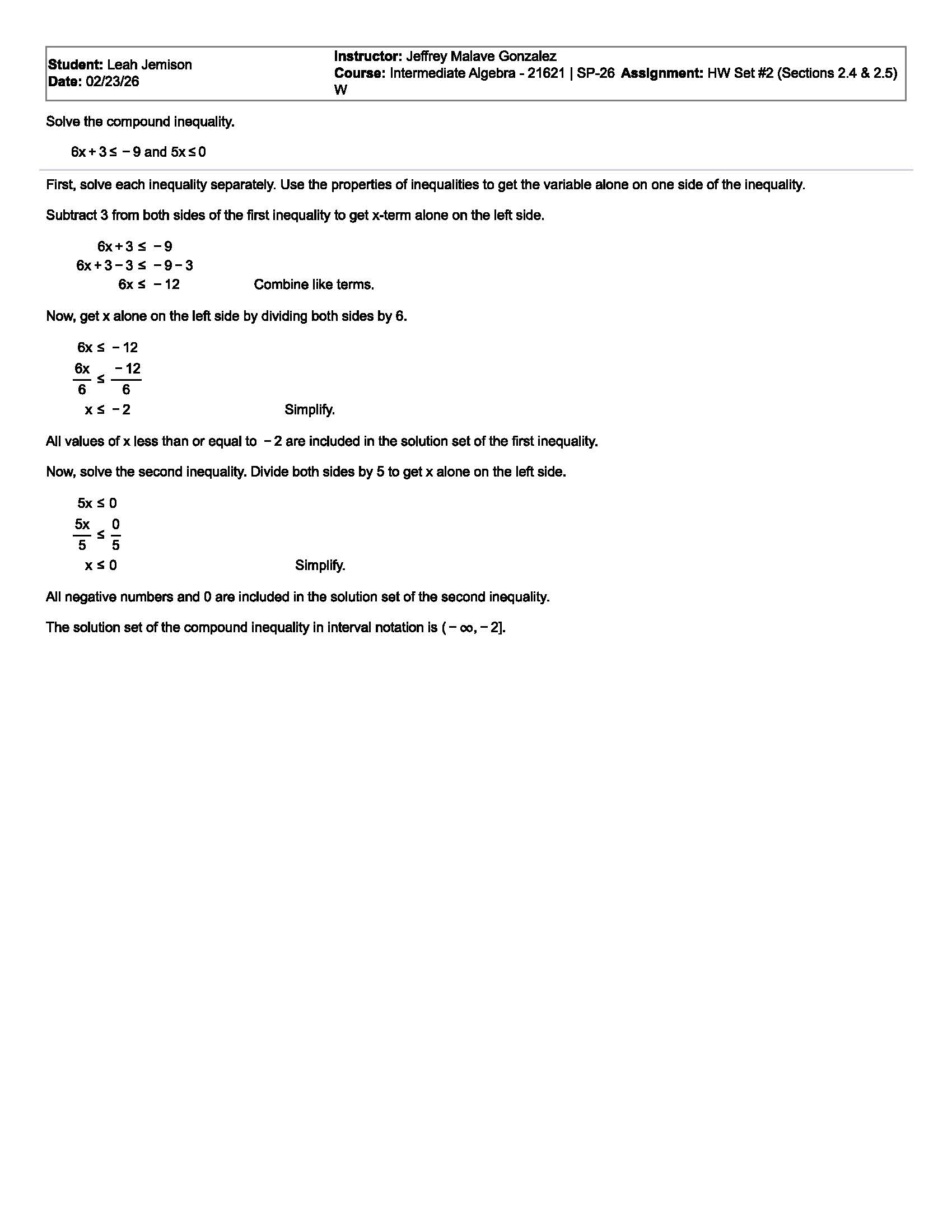
Q1. Solve the compound inequality: and
Background
Topic: Compound Inequalities
This question tests your ability to solve compound inequalities by isolating the variable in each inequality and then finding the intersection of their solution sets.
Key Terms and Formulas
Compound Inequality: An inequality that combines two or more inequalities, often using "and" or "or".
Interval Notation: A way to represent the set of solutions using intervals.
Properties of Inequalities: You can add, subtract, multiply, or divide both sides of an inequality by the same number (except when multiplying/dividing by a negative, which reverses the inequality).
Step-by-Step Guidance
Start by solving the first inequality: .
Subtract 3 from both sides to isolate the term: .
Combine like terms: .
Divide both sides by 6 to solve for : .
Now, solve the second inequality: .
Divide both sides by 5: .
Try solving on your own before revealing the answer!
Final Answer:
The solution set is the intersection of and , which is $x \leq -2$. In interval notation, this is .
This represents all values of that satisfy both inequalities simultaneously.
