 Back
BackSolving Compound Inequalities with 'Or' (Union of Solution Sets)
Study Guide - Smart Notes
 Tailored notes based on your materials, expanded with key definitions, examples, and context.
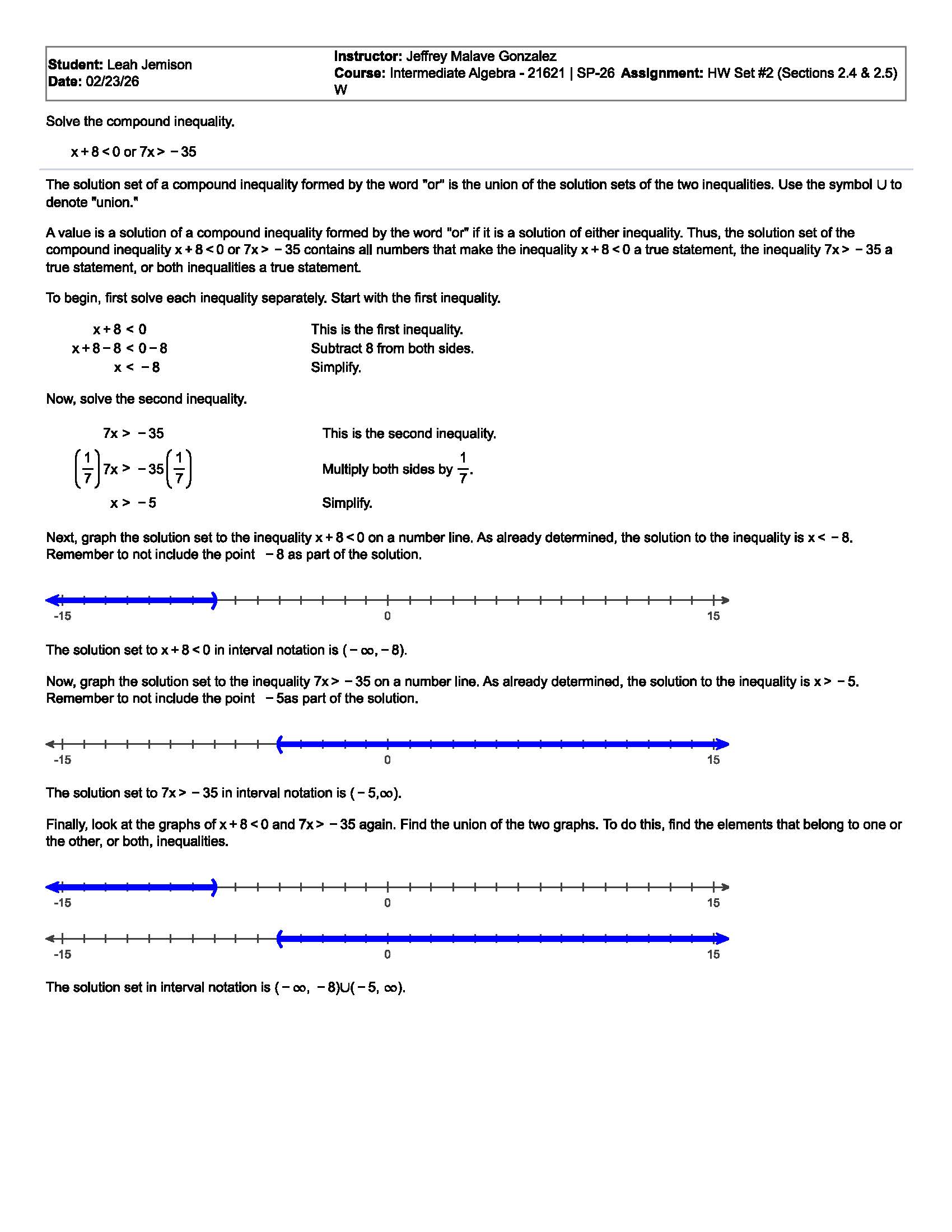
Q1. Solve the compound inequality: x + 8 < 0 or 7x > -35
Background
Topic: Compound Inequalities (Union)
This question tests your understanding of how to solve compound inequalities connected by the word "or." The solution set is the union of the solution sets for each individual inequality.
Key Terms and Formulas
Compound Inequality ("or"): A value is a solution if it satisfies at least one of the inequalities.
Union (U): The set of all elements that are in either set (or both).
Interval Notation: Used to express the solution set on the number line.
Step-by-Step Guidance
Solve the first inequality:
Subtract 8 from both sides to isolate .
Write the resulting inequality.
Solve the second inequality:
Divide both sides by 7 to solve for .
Write the resulting inequality.
Express each solution in interval notation:
For , write the interval that represents all values that satisfy this inequality.
For , write the interval that represents all values that satisfy this inequality.
Combine the solution sets using the union symbol (U):
Write the union of the two intervals to represent the complete solution set.
Optionally, sketch or interpret the solution on a number line to visualize the union of the two sets.
Try solving on your own before revealing the answer!
Final Answer:
We solved each inequality separately, expressed their solutions in interval notation, and took the union to find the complete solution set.
