 Back
BackSolving Equations for a Specified Variable: Isolating M
Study Guide - Smart Notes
 Tailored notes based on your materials, expanded with key definitions, examples, and context.
Solving Equations for a Specified Variable
General Steps for Solving for a Variable
When asked to solve an equation for a specified variable, follow a systematic approach to isolate the variable. This process is fundamental in intermediate algebra and is often used in formulas and applications.
Step 1: Clear the equation of fractions by multiplying each side by the least common denominator.
Step 2: Use the distributive property to remove grouping symbols such as parentheses.
Step 3: Combine like terms on each side of the equation.
Step 4: Use the addition property of equality to rewrite the equation as an equivalent equation with terms containing the specified variable on one side and all other terms on the other side.
Step 5: Use the distributive property and the multiplication property of equality to isolate the specified variable.
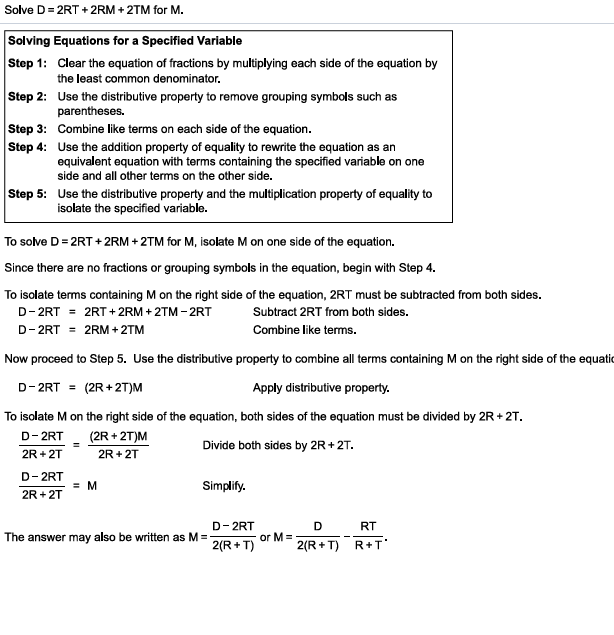
Solving D = 2RT + 2RM + 2TM for M
Step-by-Step Solution
To solve the equation for , follow these steps:
Identify terms containing M: Since there are no fractions or grouping symbols, begin with Step 4. Move all terms containing to one side by subtracting from both sides:
Combine like terms: Both and contain . Factor using the distributive property:
Isolate M: Divide both sides by to solve for :
Alternative Forms
The solution for can also be written in different forms for clarity or further simplification:
Key Concepts and Properties
Distributive Property: Used to factor or expand expressions, e.g., .
Additive Property of Equality: Allows subtraction or addition of the same value from both sides of an equation.
Multiplication Property of Equality: Allows division or multiplication of both sides by the same nonzero value.
Example Application
If , , and , substitute into the formula:
Summary Table: Steps for Solving for a Variable
Step | Description |
|---|---|
1 | Clear fractions |
2 | Remove grouping symbols |
3 | Combine like terms |
4 | Move terms with specified variable to one side |
5 | Isolate the variable |
