 Back
BackSolving Equations for a Specified Variable: Isolating Variables in Algebraic Expressions
Study Guide - Smart Notes
 Tailored notes based on your materials, expanded with key definitions, examples, and context.
Solving Equations for a Specified Variable
General Steps for Isolating a Variable
Solving equations for a specified variable is a fundamental skill in intermediate algebra. The process involves manipulating the equation to isolate the desired variable on one side, using algebraic properties and operations. The following steps outline a systematic approach:
Step 1: Clear the equation of fractions by multiplying each side by the least common denominator.
Step 2: Use the distributive property to remove grouping symbols such as parentheses.
Step 3: Combine like terms on each side of the equation.
Step 4: Use the addition property of equality to rewrite the equation as an equivalent equation with terms containing the specified variable on one side and all other terms on the other side.
Step 5: Use the distributive property and the multiplication property of equality to isolate the specified variable.
Step | Description |
|---|---|
1 | Clear fractions |
2 | Remove grouping symbols |
3 | Combine like terms |
4 | Move terms to isolate variable |
5 | Isolate variable using multiplication/division |
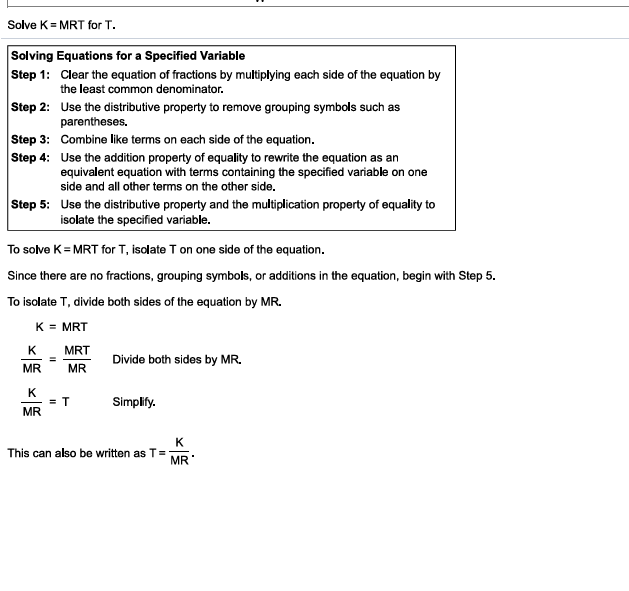
Example: Solving K = MRT for T
To solve the equation K = MRT for T, follow the steps to isolate T:
Since there are no fractions, grouping symbols, or additions, begin with Step 5.
Divide both sides of the equation by MR to isolate T.
Step-by-step solution:
Start with:
Divide both sides by MR:
Simplify:
Or, written as:
Key Points:
Isolating a variable often involves using the multiplication or division property of equality.
Always perform the same operation on both sides of the equation to maintain equality.
Check your result by substituting back into the original equation.
Additional info: The process shown is a classic example of solving for a variable in a formula, which is a common skill in algebra and is directly relevant to Chapter 2: Equations, Inequalities, and Problem Solving.
