Back
BackSolving Equations for a Specified Variable: Step-by-Step Guide
Study Guide - Smart Notes
 Tailored notes based on your materials, expanded with key definitions, examples, and context.
Solving Equations for a Specified Variable
Step-by-Step Process
Solving equations for a specified variable is a fundamental skill in intermediate algebra. This process involves isolating one variable in terms of others, which is essential for manipulating formulas and solving real-world problems.
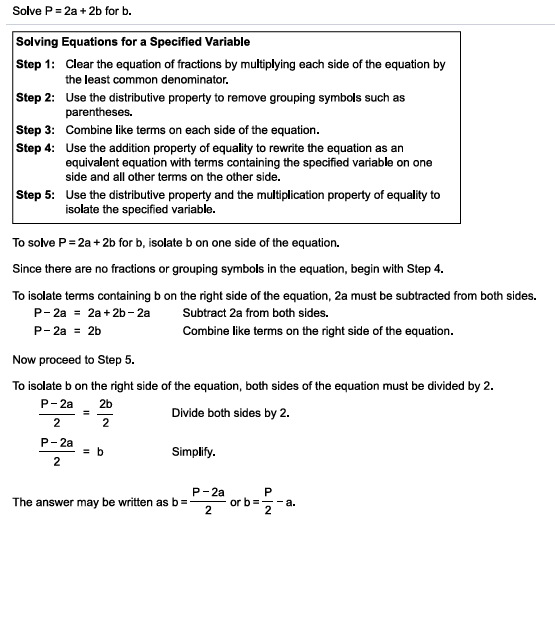
Step 1: Clear the equation of fractions by multiplying each side by the least common denominator.
Step 2: Use the distributive property to remove grouping symbols such as parentheses.
Step 3: Combine like terms on each side of the equation.
Step 4: Use the addition property of equality to rewrite the equation as an equivalent equation with terms containing the specified variable on one side and all other terms on the other side.
Step 5: Use the distributive property and the multiplication property of equality to isolate the specified variable.
Example: Solving P = 2a + 2b for b
To solve the equation P = 2a + 2b for b, follow these steps:
Identify the variable to isolate: We want to solve for b.
Check for fractions or grouping symbols: There are none, so begin with Step 4.
Subtract 2a from both sides:
Divide both sides by 2 to isolate b:
Alternative form: The answer may also be written as .
Key Properties Used:
Addition Property of Equality: Allows subtraction of the same value from both sides.
Multiplication Property of Equality: Allows division of both sides by the same value.
Applications: This method is used to rearrange formulas in geometry, physics, and other sciences, such as solving for a side length given perimeter or isolating a variable in a linear equation.