 Back
BackSolving Formulas for a Specified Variable: Isolating Variables in Equations
Study Guide - Smart Notes
 Tailored notes based on your materials, expanded with key definitions, examples, and context.
Solving Formulas for a Specified Variable
Isolating a Variable in an Equation
In intermediate algebra, it is often necessary to solve a formula for one of its variables. This process involves treating the specified variable as the only unknown and manipulating the equation to isolate it. The other variables are considered constants for the purpose of solving.
Key Point 1: Treat all other variables as constants when solving for the specified variable.
Key Point 2: Use properties of equality (addition, subtraction, multiplication, division) to isolate the variable.
Key Point 3: The goal is to have the specified variable alone on one side of the equation.
Example: Solving x = yz for y
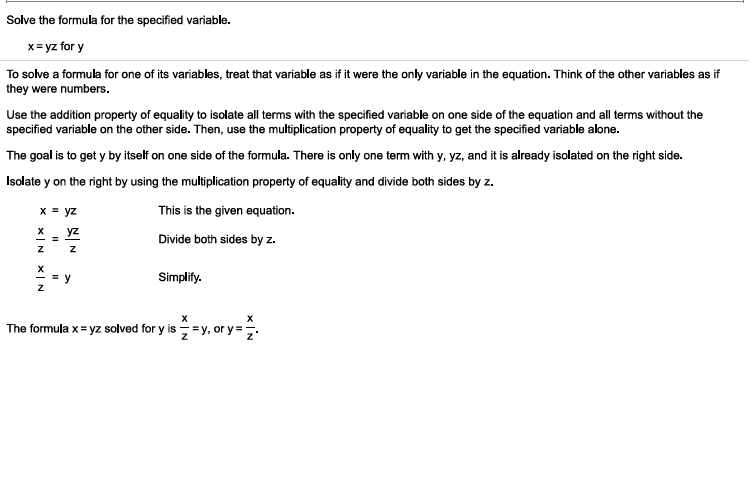
Consider the formula . To solve for y, follow these steps:
Step 1: Identify the variable to isolate (y).
Step 2: Use the multiplication property of equality to divide both sides by z.
Step 3: Simplify the equation.
The steps are shown below:
Given equation:
Divide both sides by :
Simplify:
Therefore, the formula solved for is:
General Strategy for Solving for a Variable
When solving for a variable in any formula:
Isolate all terms containing the specified variable on one side.
Move all other terms to the opposite side using addition or subtraction.
Use multiplication or division to get the variable alone.
Example Application: This technique is used in physics, chemistry, and mathematics to rearrange formulas for practical problem solving.
