Back
BackSolving Linear Equations Using Properties of Equality
Study Guide - Smart Notes
 Tailored notes based on your materials, expanded with key definitions, examples, and context.
Equations, Inequalities, and Problem Solving
Solving Linear Equations
Solving linear equations is a fundamental skill in intermediate algebra. The process involves applying algebraic properties to isolate the variable and verify the solution.
Distributive Property: Used to remove parentheses by multiplying each term inside by the factor outside.
Combining Like Terms: Simplifies the equation by adding or subtracting terms with the same variable or constant.
Addition Property of Equality: Allows moving terms from one side of the equation to the other by adding or subtracting the same value from both sides.
Division Property of Equality: Used to isolate the variable by dividing both sides by the coefficient of the variable.
Step-by-Step Example
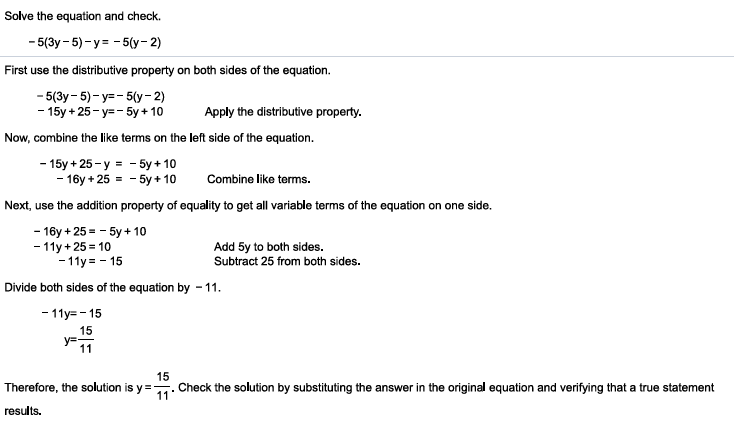
Consider the equation:
Apply the distributive property:
Combine like terms on the left side:
Use the addition property of equality:
Add to both sides:
Subtract $25$ from both sides:
Divide both sides by :
Check the solution:
Substitute back into the original equation to verify that both sides are equal.
Key Terms
Linear Equation: An equation involving only the first power of the variable.
Distributive Property:
Like Terms: Terms that have the same variable raised to the same power.
Properties of Equality: Rules that allow manipulation of equations to maintain equality.
Example Application
Solving equations like this is essential for algebraic problem solving, including applications in science, engineering, and everyday life.