Back
BackSolving Linear Equations Using the Addition Property of Equality
Study Guide - Smart Notes
 Tailored notes based on your materials, expanded with key definitions, examples, and context.
Equations, Inequalities, and Problem Solving
Solving Linear Equations
Solving linear equations is a fundamental skill in intermediate algebra. The goal is to isolate the variable on one side of the equation using properties of equality, such as the addition property.
Linear Equation: An equation of the form ax + b = c, where a, b, and c are constants.
Addition Property of Equality: If you add (or subtract) the same number to both sides of an equation, the equality is maintained.
Example: Solve and Check
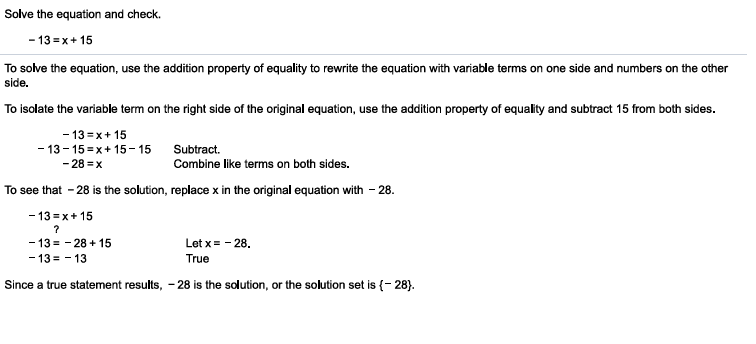
Consider the equation:
Step 1: Isolate the variable. Subtract 15 from both sides to move all variable terms to one side and constants to the other:
Step 2: Check the solution. Substitute x = -28 back into the original equation:
Since the statement is true, -28 is the solution.
Solution Set: { -28 }
Key Points
Always perform the same operation on both sides of the equation to maintain equality.
Check your solution by substituting the value back into the original equation.
The solution set is written using curly braces, e.g., { -28 }.