 Back
BackSolving Linear Equations with Fractions: Step-by-Step Guide
Study Guide - Smart Notes
 Tailored notes based on your materials, expanded with key definitions, examples, and context.
Solving Linear Equations with Fractions
Clearing Fractions Using the Least Common Denominator (LCD)
When solving linear equations that contain fractions, it is often helpful to clear the fractions by multiplying both sides of the equation by the least common denominator (LCD) of all the fractions involved. This process simplifies the equation and makes it easier to solve.
Least Common Denominator (LCD): The smallest number that is a common multiple of all denominators in the equation.
Multiplying both sides: Multiply every term in the equation by the LCD to eliminate denominators.
Distributive Property: Apply the distributive property to ensure each term is multiplied correctly.
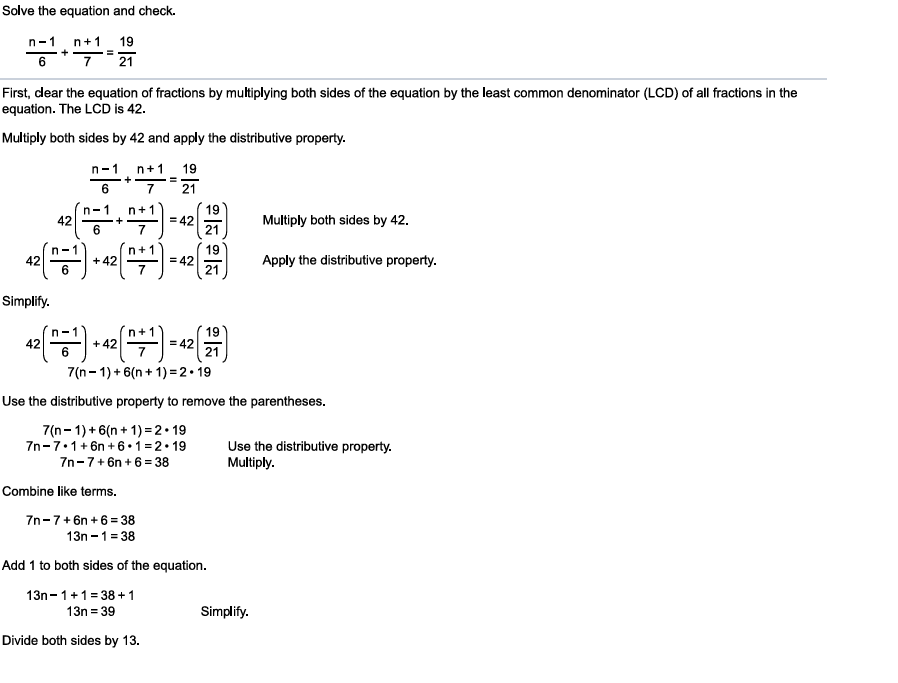
Example: Solve the equation and check:
Step-by-Step Solution
Identify the LCD: The denominators are 6, 7, and 21. The LCD is 42.
Multiply both sides by 42:
Apply the distributive property to each term:
Simplify each term:
So,
Expand and combine like terms:
Expand:
Combine like terms:
Solve for n:
Add 1 to both sides:
Divide both sides by 13:
Key Concepts and Properties
Distributive Property:
Combining Like Terms: Add or subtract terms with the same variable and exponent.
Solving Linear Equations: Isolate the variable by performing inverse operations.
Checking the Solution
Substitute back into the original equation to verify:
Find a common denominator (21):
The solution checks out.
Summary Table: Steps for Solving Linear Equations with Fractions
Step | Description |
|---|---|
1. Find LCD | Identify the least common denominator of all fractions. |
2. Multiply | Multiply every term by the LCD to clear fractions. |
3. Simplify | Apply the distributive property and combine like terms. |
4. Solve | Isolate the variable and solve for its value. |
5. Check | Substitute the solution back into the original equation. |
