 Back
BackSolving Linear Equations with Fractions: Step-by-Step Guide
Study Guide - Smart Notes
 Tailored notes based on your materials, expanded with key definitions, examples, and context.
Equations, Inequalities, and Problem Solving
Solving Linear Equations Involving Fractions
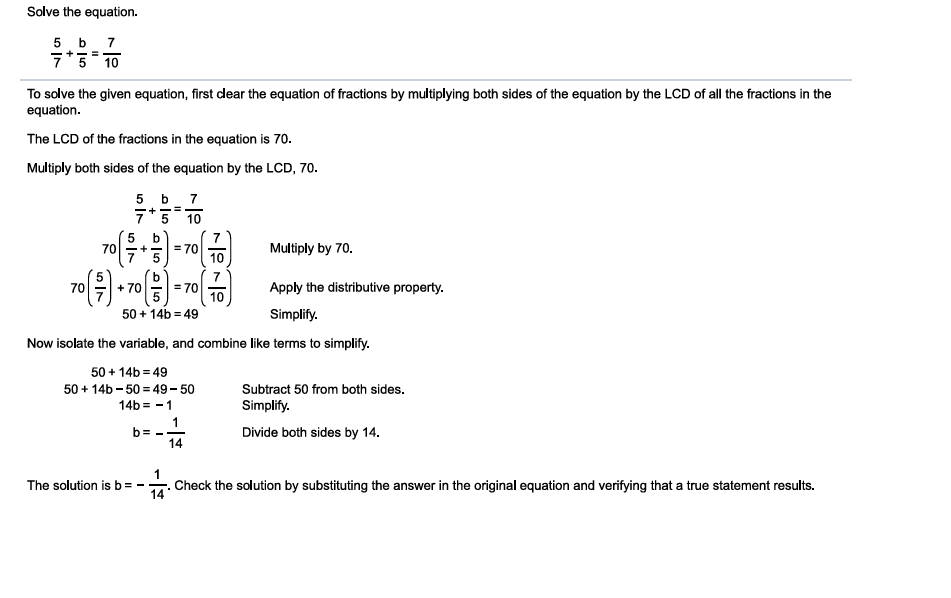
Linear equations often contain fractions, which can make solving them more challenging. The key strategy is to clear the fractions by multiplying both sides of the equation by the least common denominator (LCD) of all the fractions involved. This process simplifies the equation and allows for straightforward algebraic manipulation.
Step 1: Identify the LCD The least common denominator (LCD) is the smallest number that is a multiple of all denominators in the equation. For example, in the equation , the denominators are 7, 5, and 10. The LCD is 70.
Step 2: Multiply Both Sides by the LCD Multiplying each term by the LCD eliminates the fractions:
Apply the distributive property:
Simplify each term:
Step 3: Isolate the Variable Combine like terms and solve for the variable:
Subtract 50 from both sides:
Divide both sides by 14:
Step 4: Check the Solution Substitute the value of back into the original equation to verify that it results in a true statement.
Example: Solve Following the steps above, the solution is .
Additional info: Clearing fractions is a fundamental technique in algebra that simplifies equations and is essential for solving more complex problems involving rational expressions.
