Back
BackSolving Linear Equations with Variable Terms on Both Sides
Study Guide - Smart Notes
 Tailored notes based on your materials, expanded with key definitions, examples, and context.
Equations, Inequalities, and Problem Solving
Solving Linear Equations with Variable Terms on Both Sides
Linear equations often contain variable terms on both sides, requiring systematic steps to isolate the variable and solve for its value. The process involves applying properties of equality and algebraic manipulation.
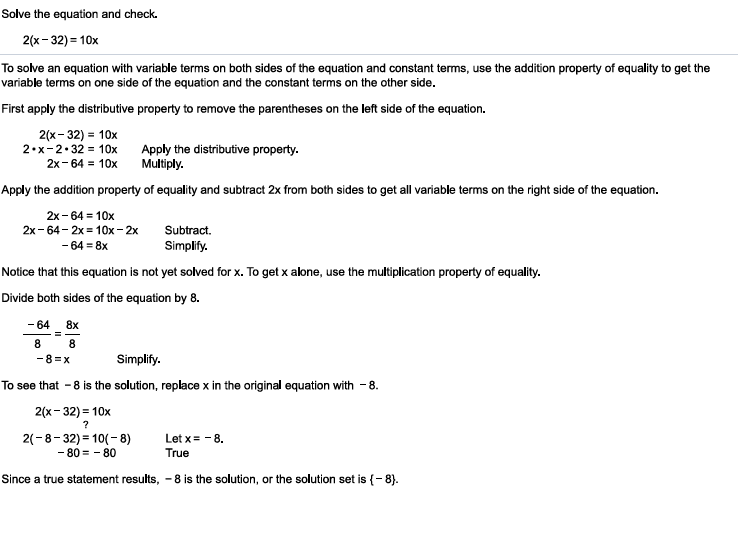
Step 1: Apply the Distributive Property The distributive property removes parentheses and simplifies expressions. For example, in the equation , distribute the 2:
Step 2: Use the Addition Property of Equality Move all variable terms to one side and constant terms to the other by adding or subtracting terms from both sides:
Step 3: Use the Multiplication Property of Equality Isolate the variable by dividing both sides by the coefficient of the variable:
Step 4: Check the Solution Substitute the solution back into the original equation to verify correctness: (True statement)
Key Terms:
Distributive Property:
Addition Property of Equality: If , then
Multiplication Property of Equality: If , then (for )
Example: Solve
Distribute:
Subtract :
Divide by 8:
Check:
The solution set is {}.