 Back
BackSolving Linear Inequalities and Expressing Solutions in Interval Notation
Study Guide - Smart Notes
 Tailored notes based on your materials, expanded with key definitions, examples, and context.
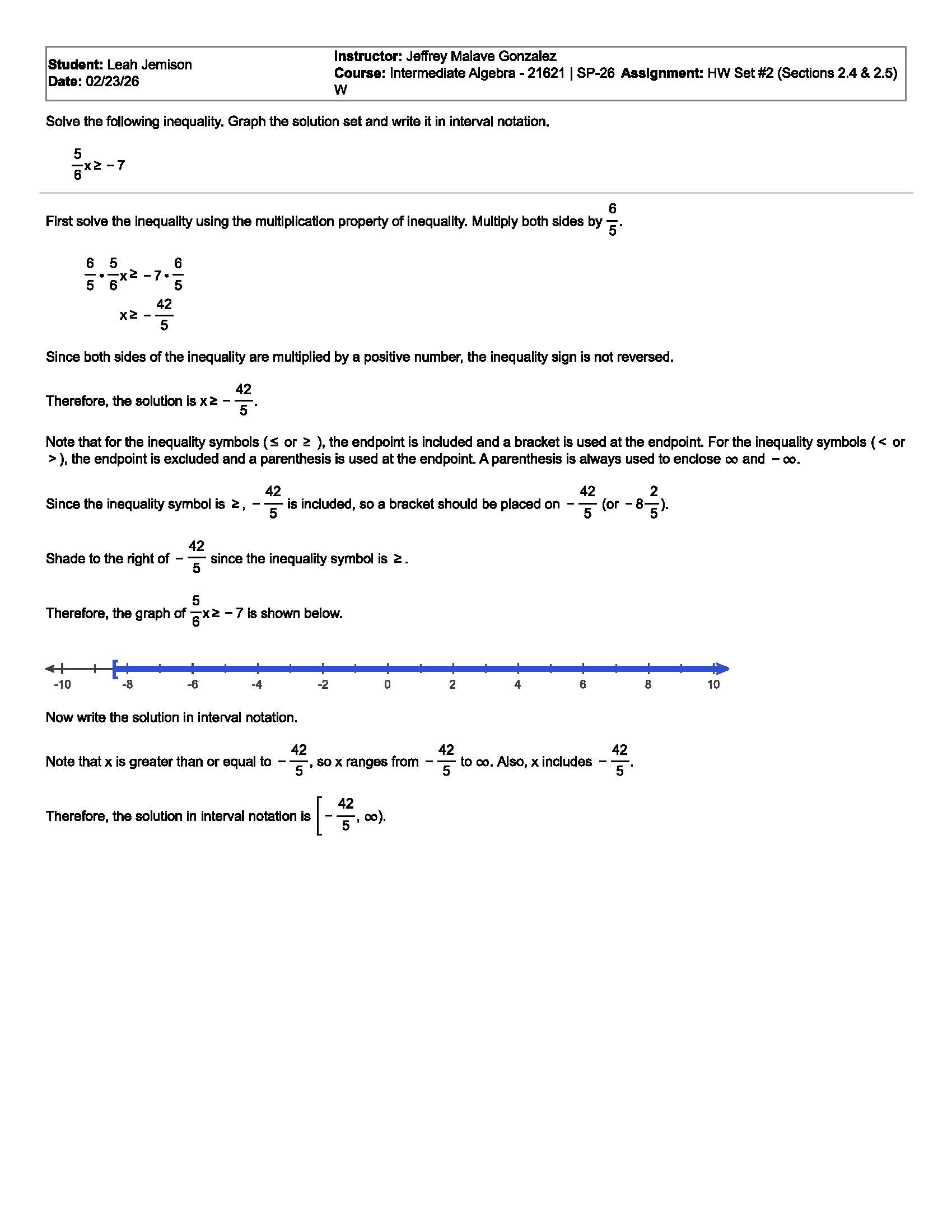
Q1. Solve the following inequality. Graph the solution set and write it in interval notation:
Background
Topic: Linear Inequalities
This question tests your understanding of how to solve linear inequalities, graph the solution on a number line, and express the solution in interval notation. It also checks your knowledge of how multiplying or dividing both sides of an inequality by a positive number affects the inequality sign.
Key Terms and Formulas
Linear Inequality: An inequality that involves a linear expression, such as .
Multiplication Property of Inequality: If you multiply or divide both sides of an inequality by a positive number, the direction of the inequality does not change.
Interval Notation: A way to describe the set of solutions using brackets [ ] for included endpoints and parentheses ( ) for excluded endpoints.
Step-by-Step Guidance
Start by isolating in the inequality . To do this, multiply both sides by the reciprocal of , which is .
Apply the multiplication property of inequality: .
Simplify the left side so that is by itself, and simplify the right side by multiplying by .
Since you are multiplying both sides by a positive number, the inequality sign remains the same.
Express the solution as (your simplified value from the previous step).
Try solving on your own before revealing the answer!
Final Answer:
The solution set includes all values greater than or equal to , which is shown on the number line with a bracket at and shading to the right.
