Back
BackSolving Perimeter Problems with Linear Equations
Study Guide - Smart Notes
 Tailored notes based on your materials, expanded with key definitions, examples, and context.
Equations, Inequalities, and Problem Solving
Solving Perimeter Problems Using Linear Equations
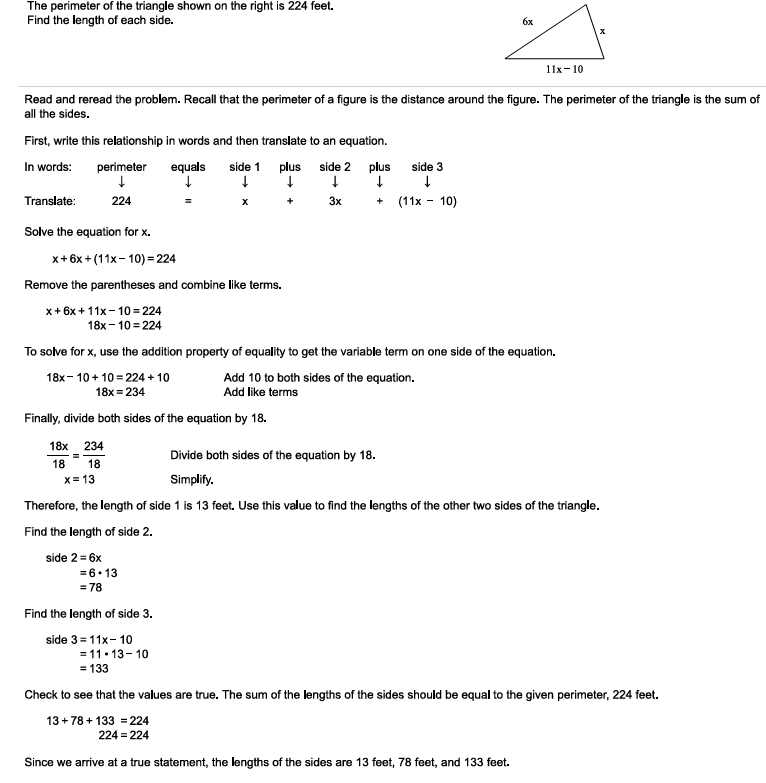
Perimeter problems often require translating a geometric scenario into an algebraic equation. In this example, the perimeter of a triangle is given, and the lengths of its sides are expressed in terms of a variable. The task is to find the value of the variable and then determine the length of each side.
Perimeter Definition: The perimeter of a figure is the total distance around it, found by summing the lengths of all sides.
Translating Words to Equations: Express the relationship in words, then translate to an equation. For a triangle:
In words: perimeter = side 1 + side 2 + side 3
In equation:
Combining Like Terms: Remove parentheses and combine terms:
Solving for the Variable: Use algebraic properties to isolate :
Add 10 to both sides:
Divide both sides by 18:
Finding Side Lengths: Substitute back into the expressions for each side:
Side 1:
Side 2:
Side 3:
Verification: Check that the sum matches the given perimeter:
Example: If a triangle has sides , , and and a perimeter of 224 feet, solve for and find the length of each side.
Step-by-step Solution:
Write the equation:
Combine like terms:
Add 10:
Divide by 18:
Side 1: $13$ feet
Side 2: $78$ feet
Side 3: $133$ feet
Application: This method can be used for any polygon where side lengths are given in terms of a variable and the perimeter is known.