 Back
Solving Rational Equations and Applications in Intermediate Algebra
Study Guide - Smart Notes
 Tailored notes based on your materials, expanded with key definitions, examples, and context.
Solving Equations Containing Rational Expressions
Rational Equations: Definition and Structure
A rational equation is an equation that contains one or more rational (fractional) expressions. Rational expressions are fractions in which the numerator and/or denominator are polynomials. Solving rational equations is a fundamental skill in Intermediate Algebra, especially for applications involving rates, work, and other real-world scenarios.
Equation vs. Expression: An equation contains an equal sign (=), while an expression does not.
Examples of Rational Equations:
Steps for Solving Rational Equations
To solve rational equations, follow these systematic steps:
Find the Least Common Denominator (LCD): Identify the LCD of all fractions in the equation.
Multiply Both Sides by the LCD: Multiply every term by the LCD to eliminate denominators.
Simplify: Remove parentheses and combine like terms on each side.
Solve: Solve the resulting equation for the variable.
Check Solutions: Substitute solutions back into the original equation to ensure no denominator becomes zero. If a solution makes any denominator zero, it is called an extraneous solution and must be discarded.
Example: Solving Rational Equations
Example A: Solve
Example B: Solve
Solving Rational Equations with Variables in the Denominator
When a variable appears in the denominator, it is essential to check all proposed solutions. Any value that makes the denominator zero is not a valid solution (extraneous solution).
Extraneous Solution: A solution that, when substituted, makes the denominator zero and is therefore not valid.
Example: Variable in Denominator
Example C: Solve
Example D: Solve
Solving Rational Equations for a Specified Variable
Isolating a Variable in Rational Equations
Sometimes, rational equations are solved for a specified variable rather than a numerical value. The process is similar: treat the specified variable as the unknown and use algebraic manipulation to isolate it.
Example: Solve for .
Example: Solve for .
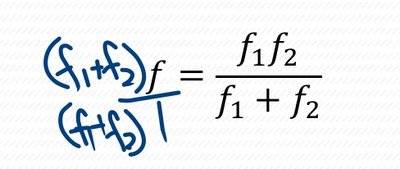
Applications: Work Problems
Work Rate Equations
Work problems involve two or more people or machines working together to complete a task. The combined work rate is the sum of individual rates. The standard formula is:
Or, rewritten:
This formula can be extended to more than two workers or machines.
Examples of Work Problems
Example: Melissa can clean a house in 4 hours, Zack in 5 hours. How long will it take them together?
Example: Chris and Mark together check plants in 24 minutes; Chris alone takes 36 minutes. How long for Mark alone?
Example: One hose fills a pond in 45 minutes, two hoses in 20 minutes. Find the time for the second hose alone.
Example: Three machines fill a quota in 5, 6, and 7.5 hours. Find the time if all run together.
Example: Inlet pipe fills a tank in 1 hour 32 minutes, outlet empties in 1 hour. Find time to empty if both are open.
Practice Exercises
Solving Rational Equations and Applications
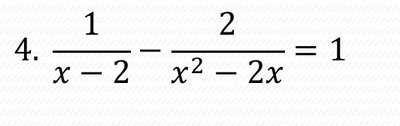
See below for equation 4:
Solve for M:
Solve for :
Work Rate: Three postal workers sort mail in 20, 30, and 60 minutes. Find time if all work together.
Summary Table: Steps for Solving Rational Equations
Step | Description |
|---|---|
1 | Find the LCD of all fractions |
2 | Multiply both sides by the LCD |
3 | Simplify and combine like terms |
4 | Solve for the variable |
5 | Check for extraneous solutions |
