Back
BackSolving Word Problems: Consecutive Even Integers
Study Guide - Smart Notes
 Tailored notes based on your materials, expanded with key definitions, examples, and context.
Equations, Inequalities, and Problem Solving
Solving Word Problems Involving Consecutive Even Integers
Word problems involving consecutive even integers are a common application of algebraic equations. The process involves translating a real-world scenario into an algebraic equation, solving for the unknown, and interpreting the result.
Definition: Consecutive even integers are integers that follow one another in order and are each divisible by 2. For example, 26, 28, and 30.
General Strategy: Use a variable to represent the first integer, then express the next consecutive even integers in terms of this variable.
Step 1: Understand the Problem
Read and reread the problem to identify what is being asked.
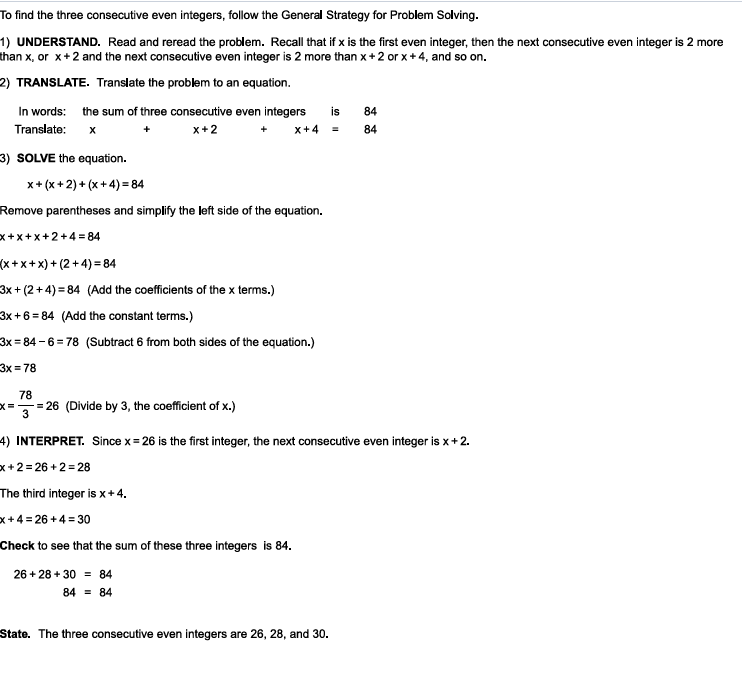
If x is the first even integer, the next consecutive even integer is x + 2, and the third is x + 4.
Step 2: Translate the Problem to an Equation
In words: The sum of three consecutive even integers is 84.
Translate:
Step 3: Solve the Equation
Remove parentheses and combine like terms:
Subtract 6 from both sides:
Divide by 3:
Step 4: Interpret the Solution
The first integer is 26.
The second integer is 28 ().
The third integer is 30 ().
Step 5: Check the Solution
Add the three integers:
Since the sum matches the original condition, the solution is correct.
Example
Problem: Find three consecutive even integers whose sum is 84.
Solution: The integers are 26, 28, and 30.
Additional info: This method can be generalized to solve for any set of consecutive even or odd integers by adjusting the increment (2 for even, 1 for odd).