 Back
BackUnderstanding Sets and Types of Real Numbers
Study Guide - Smart Notes
 Tailored notes based on your materials, expanded with key definitions, examples, and context.
Q1. Use roster notation to name the set: All letters in the word “mathematics.”
Background
Topic: Set Notation
This question is testing your ability to use roster notation, which is a way to list all elements of a set explicitly. Here, the elements are the unique letters found in the word "mathematics."
Key Terms:
Roster notation: A method of writing a set by listing its elements inside curly braces, separated by commas.
Set: A collection of distinct objects, considered as an object in its own right.
Step-by-Step Guidance
Write down the word "mathematics" and identify each unique letter.
List each unique letter only once, even if it appears multiple times in the word.
Place the letters inside curly braces, separated by commas, to form the set in roster notation.
Try solving on your own before revealing the answer!
Final Answer: {m, a, t, h, e, i, c, s}
Each unique letter from "mathematics" is listed once in the set.
Q2. Use roster notation to name the set: All odd whole numbers less than 11.
Background
Topic: Set Notation and Whole Numbers
This question is testing your ability to identify odd whole numbers and use roster notation to list them.
Key Terms:
Odd whole numbers: Whole numbers that are not divisible by 2.
Roster notation: List the numbers inside curly braces, separated by commas.
Step-by-Step Guidance
List all whole numbers less than 11: 0, 1, 2, 3, 4, 5, 6, 7, 8, 9, 10.
Identify which of these numbers are odd (not divisible by 2).
Write the odd numbers in roster notation, inside curly braces.
Try solving on your own before revealing the answer!
Final Answer: {1, 3, 5, 7, 9}
These are all the odd whole numbers less than 11.
Q3. Use set-builder notation to name the set: All odd whole numbers less than 11.
Background
Topic: Set-Builder Notation
This question is testing your ability to use set-builder notation, which describes the properties of elements in a set rather than listing them explicitly.
Key Terms and Formula:
Set-builder notation: A way to describe a set by stating the property that its members share.
General form:
Step-by-Step Guidance
Define the variable (e.g., ) to represent the numbers in the set.
State the properties: is an odd whole number and .
Write the set using set-builder notation: .
Try solving on your own before revealing the answer!
Final Answer:
This notation describes all odd whole numbers less than 11.
Q4. Categorize Types of Real Numbers
Background
Topic: Real Number System
This question is testing your understanding of the different categories within the real number system, including rational, irrational, integers, whole numbers, and natural numbers.
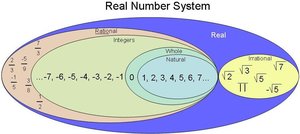
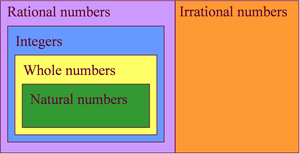
Key Terms:
Real numbers: All numbers on the number line, including rational and irrational numbers.
Rational numbers: Numbers that can be written as a fraction of two integers.
Irrational numbers: Numbers that cannot be written as a fraction; their decimal expansions are non-repeating and non-terminating.
Integers: Whole numbers and their negatives, including zero.
Whole numbers: Non-negative integers (0, 1, 2, ...).
Natural numbers: Positive integers (1, 2, 3, ...).
Step-by-Step Guidance
Review the diagrams to see how the different types of numbers are related and nested within the real number system.
Identify examples of each type: rational, irrational, integer, whole, and natural numbers.
Understand that rational numbers include integers, whole numbers, and natural numbers, while irrational numbers are separate.
Practice categorizing numbers by their properties (e.g., is rational or irrational?).
Try categorizing some numbers on your own before revealing the answer!
Final Answer: Real numbers are divided into rational and irrational numbers. Rational numbers include integers, whole numbers, and natural numbers. Irrational numbers are numbers like , , etc., that cannot be written as fractions.
The diagrams visually show the relationships and categories within the real number system.
