 Back
Introductory Biology Key Concepts
 01:35

Terms in this set (28)
Biology is the scientific study of life and living organisms.
Science cannot answer questions about the supernatural, morality, or subjective experiences; it is limited to testable and observable phenomena.
Discovery science involves inductive reasoning to make generalizations from observations, while theoretical science uses deductive reasoning to test hypotheses and predictions.
Inductive reasoning derives general principles from specific observations; deductive reasoning applies general principles to predict specific outcomes.
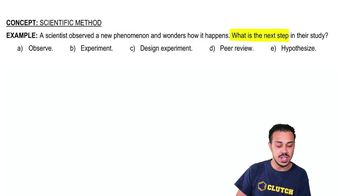
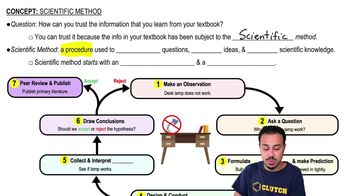
Observation, Question, Hypothesis, Experiment, Collect data, Analyze data, Conclusion.
A hypothesis is a testable and falsifiable explanation for a scientific question.
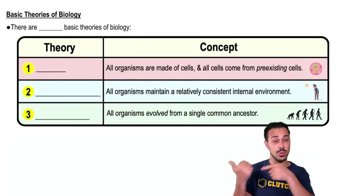
A theory is a well-supported, broad explanation for a wide range of observations and experimental results.
Levels: Atom, Molecules, Organelles, Cells, Tissues, Organs, Organ systems, Organism, Populations, Communities, Ecosystems, Biosphere.
Organization, Emergent properties vs. Reductionism, Structure and function, The cell, Genetics, Energy & matter, Interactions, Feedback regulation, Evolution.
Emergent properties arise from complex interactions at lower levels; reductionism studies parts in isolation.
Natural selection is the process where organisms better adapted to their environment tend to survive and produce more offspring.
Did – King – Phillip/David – Come – Over – For – Good – Soup (Domain, Kingdom, Phylum/Division, Class, Order, Family, Genus, Species).
About 96% of living matter is made of carbon, hydrogen, oxygen, and nitrogen.
Atoms consist of protons (positive), neutrons (neutral), and electrons (negative).
The atomic number is the number of protons in an atom's nucleus.
Isotopes are atoms of the same element with different numbers of neutrons.
Stable isotopes do not decay; radioactive isotopes decay over time and emit radiation.
Electron shells hold electrons: 1st shell = 2 electrons, 2nd and 3rd shells = up to 8 electrons each.
Ionic bonds form by transfer of electrons; covalent bonds form by sharing electrons.
Polar covalent bonds have unequal electron sharing causing partial charges; nonpolar covalent bonds share electrons equally.
Hydrogen bonds are weak attractions between a hydrogen atom and an electronegative atom like oxygen or nitrogen.
Water has adhesion, cohesion, high specific heat, high heat of vaporization, is an excellent solvent, and ice floats providing insulation.
Ice is less dense than liquid water because of its hydrogen-bonded crystal structure, which provides insulation.
pH measures the hydrogen ion concentration; lower pH is acidic, higher pH is basic.
Buffers maintain stable pH by absorbing or releasing hydrogen ions.
Carbon forms four covalent bonds, allowing diverse molecules with various lengths, branching, double bonds, and rings.
Structural isomers differ in atom arrangement; cis-trans isomers differ in spatial arrangement around double bonds; enantiomers are mirror images.
Hydroxyl, Carbonyl, Carboxyl, Amino, Sulfhydryl, Phosphate, Methyl groups affect molecule properties and reactivity.