Skip to main content
Introduction to Chemistry
My Course
Learn
Exam Prep
AI Tutor
Study Guides
Flashcards
Explore
Try the app
My Course
Learn
Exam Prep
AI Tutor
Study Guides
Flashcards
Explore
Try the app
Back
Acid-Base Reactions definitions
You can tap to flip the card.
Hydroxide Base
You can tap to flip the card.
👆
Hydroxide Base
A substance containing OH− ions that reacts with acids to form water and an ionic compound.
Track progress
Control buttons has been changed to "navigation" mode.
1/14
Related flashcards
Related practice
Recommended videos
Acid-Base Reactions quiz
Acid-Base Reactions
15 Terms
Acid-Base Reactions
14. Acids and Bases
5 problems
Topic
Buffers
14. Acids and Bases
5 problems
Topic
14. Acids and Bases
10 topics
30 problems
Chapter
Guided course
03:08
Acid-Base Reactions Concept 1
3456
views
10
rank
Guided course
00:52
Acid-Base Reactions Example 1
3046
views
6
rank
Terms in this set (14)
Hide definitions
Hydroxide Base
A substance containing OH− ions that reacts with acids to form water and an ionic compound.
Neutral Amine
A weak base composed of nitrogen and hydrogen, sometimes with carbon, that forms a salt when reacting with acids.
Salt
An ionic compound produced when an acid reacts with a base, metal, or metal oxide.
Water
A liquid formed when H+ from an acid combines with OH− from a base or with a metal oxide.
Ammonia
A neutral amine with nitrogen and hydrogen, acting as a weak base in reactions with acids.
Methylamine
A neutral amine containing carbon, nitrogen, and hydrogen, serving as a weak base in acid reactions.
Hydrogen Gas
A diatomic molecule released when acids react with metals, often observed as bubbles.
Metal Oxide
A compound of a metal with oxygen that reacts with acids to yield water and a salt.
Ionic Compound
A substance formed from the electrostatic attraction between positive and negative ions, often called a salt.
Ammonium Nitrate
An ionic compound formed when nitric acid reacts with ammonia, commonly used as a fertilizer.
Iron(II) Sulfate
A salt produced when sulfuric acid reacts with iron, appearing in aqueous solution.
Iron(II) Chloride
A salt formed when an acid reacts with iron(II) oxide, typically found in solution.
Pattern Recognition
A skill used to identify the type of compound reacting with an acid to predict the resulting products.
Product
A substance generated from an acid-base reaction, such as water, a salt, or hydrogen gas.
 BackBack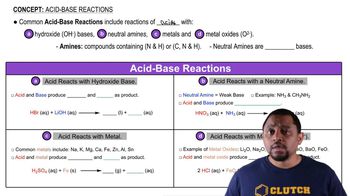
 03:08
03:08