Skip to main content
Introduction to Chemistry
My Course
Learn
Exam Prep
AI Tutor
Study Guides
Flashcards
Explore
Try the app
My Course
Learn
Exam Prep
AI Tutor
Study Guides
Flashcards
Explore
Try the app
Back
Alpha Decay quiz
You can tap to flip the card.
What is an alpha particle composed of?
You can tap to flip the card.
👆
What is an alpha particle composed of?
An alpha particle consists of 2 protons and 2 neutrons.
Track progress
Control buttons has been changed to "navigation" mode.
1/15
Related flashcards
Related practice
Recommended videos
Alpha Decay definitions
Alpha Decay
13 Terms
Alpha Decay
17. Radioactivity and Nuclear Chemistry
5 problems
Topic
Beta Decay
17. Radioactivity and Nuclear Chemistry
5 problems
Topic
17. Radioactivity and Nuclear Chemistry
7 topics
20 problems
Chapter
Guided course
04:23
Alpha Decay Concept 1
4054
views
28
rank
Guided course
01:33
Alpha Decay Concept 2
4020
views
22
rank
Guided course
02:10
Alpha Decay Example 1
4014
views
36
rank
Terms in this set (15)
Hide definitions
What is an alpha particle composed of?
An alpha particle consists of 2 protons and 2 neutrons.
How is an alpha particle represented in nuclear equations?
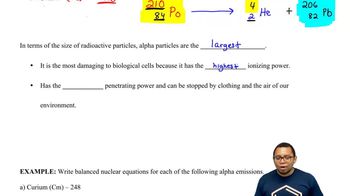
It is represented as 4/2 He, indicating an atomic mass of 4 and atomic number of 2.
Which element on the periodic table has the same atomic mass and atomic number as an alpha particle?
Helium has an atomic mass of 4 and atomic number of 2, the same as an alpha particle.
What happens to polonium-210 when it undergoes alpha decay?
Polonium-210 emits an alpha particle and transforms into lead-206.
Why must nuclear reactions be balanced?
Both atomic mass and atomic numbers must be equal on both sides of the reaction.
What is the atomic mass and atomic number of polonium-210?
Polonium-210 has an atomic mass of 210 and an atomic number of 84.
After alpha decay, what is the atomic mass and atomic number of the new element formed from polonium-210?
The new element, lead-206, has an atomic mass of 206 and atomic number of 82.
What is the largest type of radioactive particle?
The alpha particle is the largest among radioactive particles.
Why are alpha particles considered highly damaging to biological cells?
They have the highest ionizing power, which can severely damage biological cells if internal exposure occurs.
Why is internal exposure to alpha particles rare?
Alpha particles have the lowest penetrating power and are easily blocked by skin, clothing, or air.
What provides protection against alpha particles?
Clothing and even air can protect against alpha particles due to their low penetrating power.
How can alpha particles enter the human body?
Alpha particles can enter the body through ingestion of contaminated food or water, or exposure in a nuclear facility.
What is the fate of the alpha particle emitted during alpha decay?
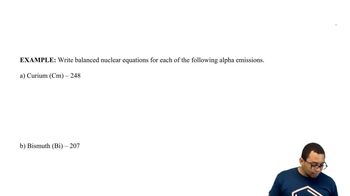
The alpha particle is emitted as waste and is not part of the new element formed.
What is the relationship between isotopes and alpha decay?
Alpha decay can occur with different isotopes, which have the same atomic number but different atomic masses.
What must be true for atomic mass and atomic number in a balanced nuclear reaction?
The sum of atomic masses and atomic numbers must be equal on both sides of the equation.
 BackBack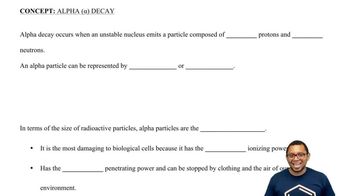
 04:23
04:23