Skip to main content
Introduction to Chemistry
My Course
Learn
Exam Prep
AI Tutor
Study Guides
Flashcards
Explore
Try the app
My Course
Learn
Exam Prep
AI Tutor
Study Guides
Flashcards
Explore
Try the app
Back
Beta Decay definitions
You can tap to flip the card.
Beta Decay
You can tap to flip the card.
👆
Beta Decay
A process where an unstable nucleus emits an electron, altering its atomic number but not its atomic mass.
Track progress
Control buttons has been changed to "navigation" mode.
1/13
Related flashcards
Related practice
Recommended videos
Beta Decay quiz
Beta Decay
15 Terms
Beta Decay
17. Radioactivity and Nuclear Chemistry
5 problems
Topic
Gamma Emission
17. Radioactivity and Nuclear Chemistry
5 problems
Topic
17. Radioactivity and Nuclear Chemistry
7 topics
20 problems
Chapter
Guided course
01:26
Beta Decay Example 1
4064
views
16
rank
Guided course
06:46
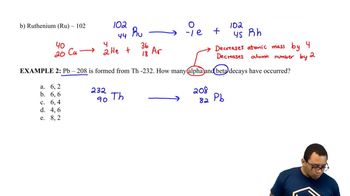
Beta Decay Example 2
4164
views
25
rank
Guided course
01:54
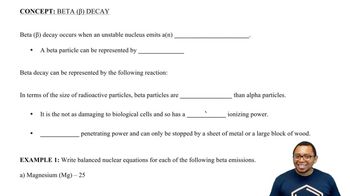
Beta Decay Concept 1
4393
views
20
rank
Terms in this set (13)
Hide definitions
Beta Decay
A process where an unstable nucleus emits an electron, altering its atomic number but not its atomic mass.
Electron
A subatomic particle with negligible mass and a negative charge, emitted during certain nuclear reactions.
Beta Particle
A high-speed electron released from a nucleus, carrying an atomic number of -1 and mass of 0.
Atomic Mass
The total number of protons and neutrons in a nucleus, remaining unchanged during this nuclear process.
Atomic Number
A value representing the number of protons in a nucleus, which increases by one after this nuclear event.
Mercury-201
An isotope with atomic number 80 and mass 201, serving as an example of a nucleus undergoing this transformation.
Thallium-201
A product nucleus formed when an isotope with atomic number 80 emits a beta particle.
Alpha Particle
A larger radioactive particle compared to electrons, with greater ionizing power but less penetration.
Ionizing Power
The ability of radiation to remove electrons from atoms, lower for electrons than for larger radioactive particles.
Penetrating Power
The capacity of radiation to pass through materials, higher for electrons than for larger radioactive particles.
Radioactive Particle
A subatomic entity emitted from unstable nuclei, including electrons and larger particles.
Periodic Table
A chart organizing elements by atomic number, used to identify elements involved in nuclear reactions.
Sheet of Metal
A barrier capable of blocking high-speed electrons emitted from nuclei, preventing their entry into the body.
 BackBack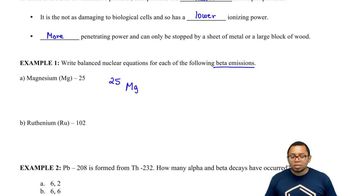
 01:26
01:26