Based on the concept of density, which type of element—solid, liquid, or gas—typically has the greatest density at standard temperature and pressure (STP)?
At standard temperature and pressure (STP), solid elements typically have the greatest density compared to liquids and gases.
What is the formula for calculating density?
Density is calculated as mass divided by volume. The formula is density = mass/volume.
Which units are commonly used for the volume of solids and liquids when calculating density?
Milliliters (mL) and cubic centimeters (cm³) are commonly used for the volume of solids and liquids. These units are interchangeable because 1 mL equals 1 cm³.
Why can milliliters and cubic centimeters be used interchangeably in density calculations for solids and liquids?
Milliliters and cubic centimeters can be used interchangeably because 1 milliliter is exactly equal to 1 cubic centimeter. This equivalence allows for easy conversion between the two units.
What units are typically used for the volume of gases when determining their density?
Liters (L) and cubic decimeters (dm³) are typically used for the volume of gases. These units are interchangeable because 1 liter equals 1 cubic decimeter.
How does the density of gases compare to that of solids and liquids?
Gases are much less dense than solids and liquids. This is why their density is measured using larger volume units like liters or cubic decimeters.
What is the unit for mass when calculating the density of any phase of matter?
The unit for mass is grams (g) when calculating density for solids, liquids, and gases. This consistency helps in comparing densities across different phases.
How can the density of a gas be expressed in terms of units?
The density of a gas can be expressed as grams per liter (g/L) or grams per cubic decimeter (g/dm³). Both units are valid due to the equivalence of liters and cubic decimeters.
Why are larger volume units used for gases in density calculations?
Larger volume units like liters are used for gases because gases occupy much more space and are less dense than solids and liquids. This makes the density values more practical and easier to work with.
What should you remember about the relationship between phase of matter and density units?
The phase of matter determines which units are most appropriate for density calculations. Solids and liquids use milliliters or cubic centimeters, while gases use liters or cubic decimeters.
 Back
Back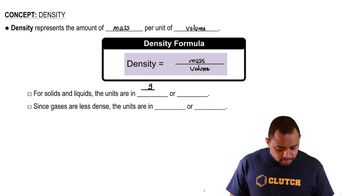
 01:56
01:56