Skip to main content
Introduction to Chemistry
My Course
Learn
Exam Prep
AI Tutor
Study Guides
Flashcards
Explore
Try the app
My Course
Learn
Exam Prep
AI Tutor
Study Guides
Flashcards
Explore
Try the app
Back
Electronic Structure: Shells quiz #1
You can tap to flip the card.
How many electron shells does a nitrogen atom have?
You can tap to flip the card.
👆
How many electron shells does a nitrogen atom have?
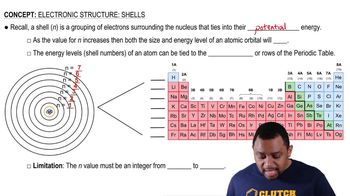
Nitrogen has two electron shells, corresponding to its position in the second period (row) of the periodic table.
Track progress
Control buttons has been changed to "navigation" mode.
1/10
Related flashcards
Related practice
Recommended videos
Electronic Structure: Shells definitions
Electronic Structure: Shells
14 Terms
Electronic Structure: Shells
9. Electrons in Atoms and the Periodic Table
5 problems
Topic
Electronic Structure: Subshells
9. Electrons in Atoms and the Periodic Table
5 problems
Topic
9. Electrons in Atoms and the Periodic Table - Part 3 of 4
12 topics
36 problems
Chapter
Guided course
00:38
Electronic Structure: Shells Example 1
3072
views
12
rank
Guided course
02:29
Electronic Structure: Shells Concept 1
3341
views
22
rank
Terms in this set (10)
Hide definitions
How many electron shells does a nitrogen atom have?
Nitrogen has two electron shells, corresponding to its position in the second period (row) of the periodic table.
How many electron shells does a fluorine atom have?
Fluorine has two electron shells, as it is located in the second period of the periodic table.
How many electron shells does an aluminum atom have?
Aluminum has three electron shells, since it is found in the third period of the periodic table.
Which electron shell in an atom has the highest energy?
The electron shell with the highest shell number (n) has the highest energy, as energy increases with increasing shell number.
Which element contains a full second energy level (second electron shell)?
Neon contains a full second energy level, as it is the last element in the second period and has a complete second shell.
Which elements have two electron shells?
Elements in the second period of the periodic table, such as lithium through neon, have two electron shells.
How many electron shells does a sodium atom have?
Sodium has three electron shells, corresponding to its position in the third period of the periodic table.
How many electron shells does a potassium atom have?
Potassium has four electron shells, as it is located in the fourth period of the periodic table.
How many electron shells does a magnesium atom have?
Magnesium has three electron shells, since it is found in the third period of the periodic table.
How many electron shells does an oxygen atom have?
Oxygen has two electron shells, as it is located in the second period of the periodic table.
 BackBack
 00:38
00:38