Skip to main content
Introduction to Chemistry
My Course
Learn
Exam Prep
AI Tutor
Study Guides
Flashcards
Explore
Try the app
My Course
Learn
Exam Prep
AI Tutor
Study Guides
Flashcards
Explore
Try the app
Back
Gamma Emission definitions
You can tap to flip the card.
Gamma Ray
You can tap to flip the card.
👆
Gamma Ray
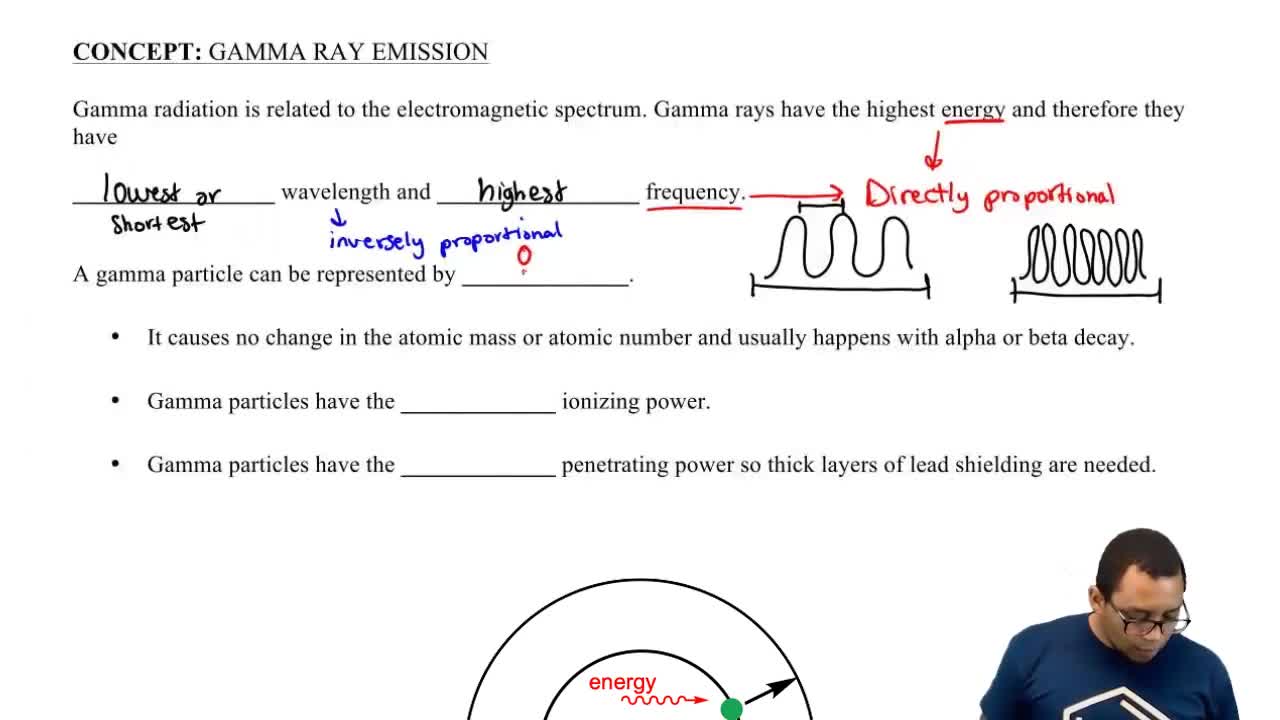
A form of electromagnetic radiation with the highest energy, highest frequency, and shortest wavelength in the spectrum.
Track progress
Control buttons has been changed to "navigation" mode.
1/15
Related flashcards
Related practice
Recommended videos
Gamma Emission quiz
Gamma Emission
15 Terms
Gamma Emission
17. Radioactivity and Nuclear Chemistry
5 problems
Topic
Positron Emission
17. Radioactivity and Nuclear Chemistry
5 problems
Topic
17. Radioactivity and Nuclear Chemistry
7 topics
20 problems
Chapter
Guided course
02:15
Gamma Emission Concept 1
3983
views
7
rank
Guided course
01:36
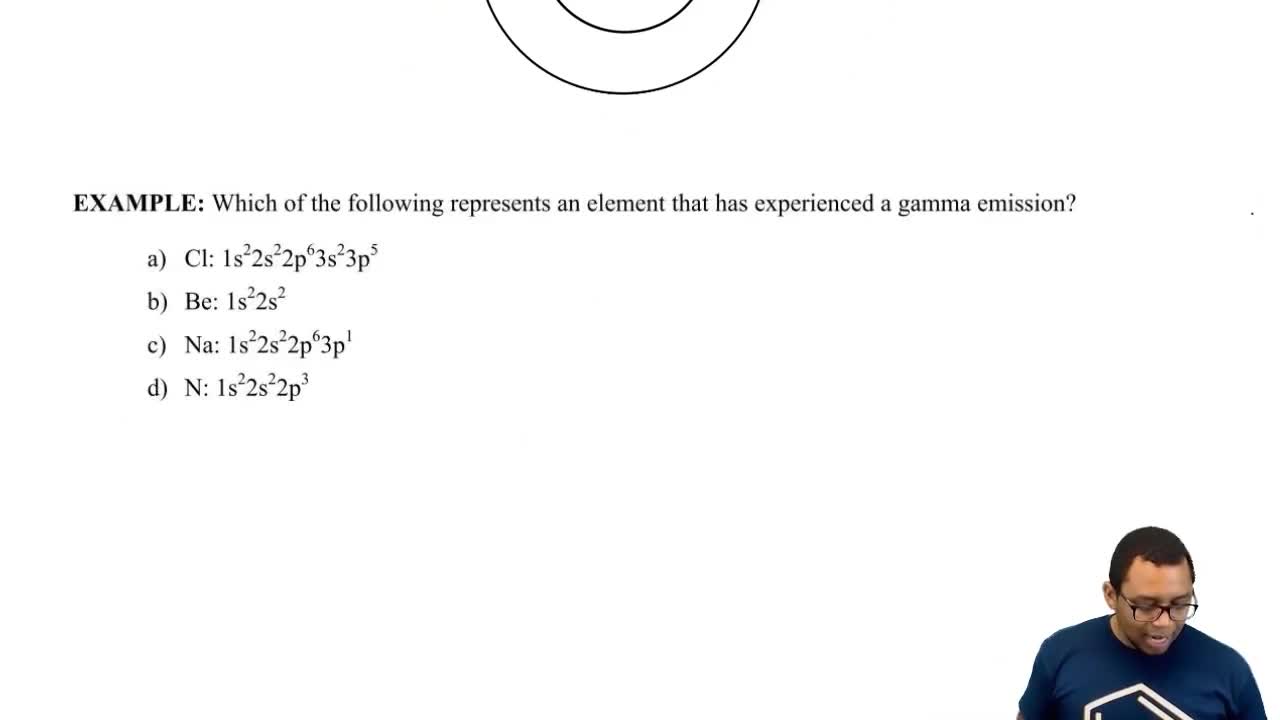
Gamma Emission Example 1
4120
views
13
rank
1
comments
Guided course
02:53
Gamma Emission Concept 2
4144
views
9
rank
Terms in this set (15)
Hide definitions
Gamma Ray
A form of electromagnetic radiation with the highest energy, highest frequency, and shortest wavelength in the spectrum.
Electromagnetic Spectrum
A range of all types of electromagnetic radiation, ordered by energy, frequency, and wavelength.
Frequency
A measure of how many wave cycles pass a point per second; higher values mean more waves in the same time.
Wavelength
The distance between consecutive wave crests; shorter values correspond to higher energy and frequency.
Energy
A property directly proportional to frequency and inversely proportional to wavelength in electromagnetic waves.
Cosmic Ray
A type of radiation with even higher energy than gamma rays, typically discussed in advanced sciences.
Gamma Particle
A representation of gamma radiation, denoted as 0 over 0 with a gamma symbol, indicating no mass or charge.
Atomic Mass
A value that remains unchanged during gamma emission, representing the total number of protons and neutrons.
Atomic Number
A value that remains unchanged during gamma emission, representing the number of protons in an atom.
Alpha Decay
A nuclear process often accompanied by gamma emission, involving the release of a helium nucleus.
Beta Decay
A nuclear process often accompanied by gamma emission, involving the transformation of a neutron to a proton or vice versa.
Excited State
A condition where an electron has absorbed energy and occupies a higher shell or orbital than its ground state.
Penetrating Power
A property describing the ability of radiation to pass through materials; highest for gamma radiation.
Ionizing Power
A property describing the ability of radiation to remove electrons from atoms; lowest for gamma radiation.
Biological Tissue
Material highly susceptible to damage from gamma radiation due to its extreme penetrating ability.
 BackBack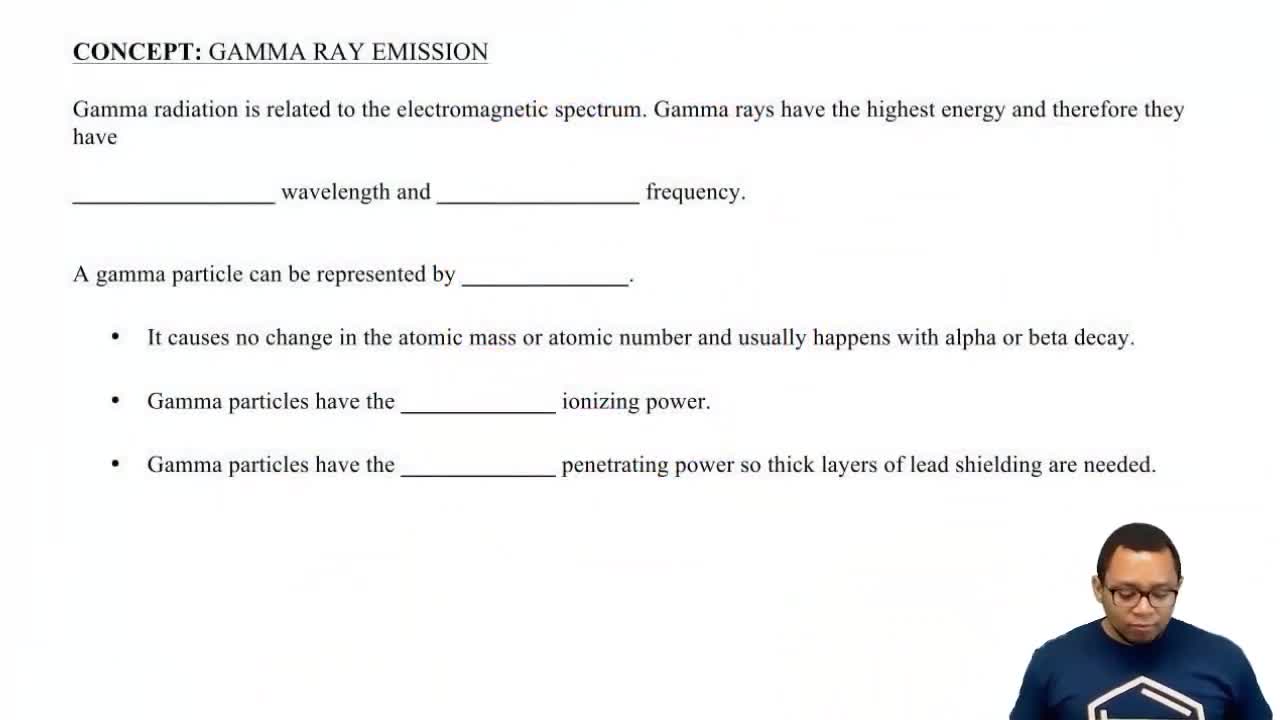
 02:15
02:15