Molarity quiz #1 Flashcards

Molarity quiz #1
Control buttons has been changed to "navigation" mode.
1/10
  • What is the molarity of a solution containing 6 moles of NaCl dissolved in 2 liters of aqueous solution?
    Molarity (M) is calculated using the formula M = moles of solute / liters of solution. For 6 moles of NaCl in 2 liters: M = 6 moles / 2 L = 3 M. The molarity is 3.0 M.
  • How many moles of sucrose are present in 2.00 liters of a 0.500 molar (M) solution?
    To find moles, use the formula: moles = molarity × liters. For a 0.500 M solution and 2.00 L: moles = 0.500 × 2.00 = 1.00 mole. There are 1.00 mole of sucrose.
  • What does the capital letter 'M' stand for in the context of solution chemistry?
    In solution chemistry, 'M' stands for molarity, which is the number of moles of solute per liter of solution.
  • How is molarity different from general concentration?
    Molarity is a specific type of concentration that measures moles of solute per liter of solution, while concentration can refer to any measure of solute in solution.
  • Why is molarity considered a conversion factor in calculations?
    Molarity connects two units—moles of solute and liters of solution—allowing it to be used as a conversion factor in dimensional analysis.
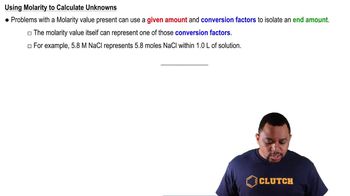
  • If you have a solution labeled as 5.8 M NaCl, what does this mean in terms of moles and liters?
    It means there are 5.8 moles of NaCl dissolved in every 1 liter of solution.
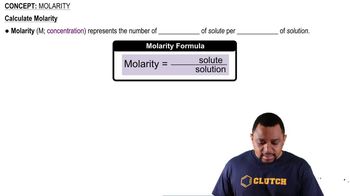
  • What is the formula for calculating molarity?
    The formula for molarity is M = moles of solute divided by liters of solution.
  • How can dimensional analysis help when working with molarity problems?
    Dimensional analysis helps organize units and conversion factors, making it easier to solve for unknowns in molarity calculations.
  • What two components are needed to calculate the molarity of a solution?
    You need the number of moles of solute and the volume of the solution in liters.
  • Why is it important to distinguish between molarity and other types of concentration?
    Distinguishing molarity is important because it specifically relates moles to liters, which is essential for accurate chemical calculations and conversions.