Skip to main content
Introduction to Chemistry
My Course
Learn
Exam Prep
AI Tutor
Study Guides
Flashcards
Explore
Try the app
My Course
Learn
Exam Prep
AI Tutor
Study Guides
Flashcards
Explore
Try the app
Back
Molecular Equations definitions
You can tap to flip the card.
Molecular Equation
You can tap to flip the card.
👆
Molecular Equation
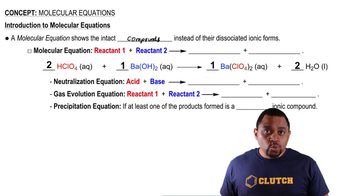
Represents chemical reactions with compounds shown intact, not as separated ions, highlighting the overall transformation.
Track progress
Control buttons has been changed to "navigation" mode.
1/14
Related flashcards
Related practice
Recommended videos
Molecular Equations quiz
Molecular Equations
15 Terms
Molecular Equations
7. Chemical Reactions
5 problems
Topic
Types of Chemical Reactions
7. Chemical Reactions
5 problems
Topic
7. Chemical Reactions
8 topics
24 problems
Chapter
Guided course
05:07
Molecular Equations Example 2
7213
views
52
rank
Guided course
02:24
Molecular Equations
9251
views
52
rank
Guided course
01:13
Molecular Equations Example 1
8012
views
54
rank
Terms in this set (14)
Hide definitions
Molecular Equation
Represents chemical reactions with compounds shown intact, not as separated ions, highlighting the overall transformation.
Aqueous Reactant
A substance dissolved in water that participates in a chemical reaction, often denoted with (aq) in equations.
Product
A substance formed as a result of a chemical reaction, appearing on the right side of a chemical equation.
Perchloric Acid
A strong acid commonly used in reactions, often found in aqueous form and represented as HClO4.
Barium Hydroxide
A strong base used in neutralization reactions, typically in aqueous solution, with the formula Ba(OH)2.
Barium Perchlorate
An ionic compound formed from barium hydroxide and perchloric acid, often appearing as a product in molecular equations.
Neutralization Equation
Describes a reaction between an acid and a base in aqueous solution, producing water and an ionic compound.
Ionic Compound
A substance composed of positively and negatively charged ions, often formed as a product in neutralization or precipitation reactions.
Gas Evolution Equation
Represents a reaction where at least one of the products is a gas, often observed as bubbling or effervescence.
Precipitation Equation
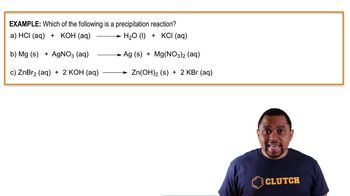
Describes a reaction where at least one solid ionic compound forms from pipeline reactants, indicating the formation of a precipitate.
Precipitate
A solid formed from a solution during a chemical reaction, typically indicating a substance with low solubility.
Solubility Rules
Guidelines used to predict whether an ionic compound will dissolve in water or form a precipitate in a reaction.
Water
A common product in neutralization reactions, formed when an acid reacts with a base, denoted as H2O.
Salt
An ionic compound produced alongside water in acid-base neutralization reactions, not necessarily sodium chloride.
 BackBack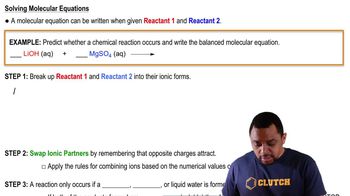
 05:07
05:07