Skip to main content
Introduction to Chemistry
My Course
Learn
Exam Prep
AI Tutor
Study Guides
Flashcards
Explore
Try the app
My Course
Learn
Exam Prep
AI Tutor
Study Guides
Flashcards
Explore
Try the app
Back
Naming Monoatomic Cations definitions
You can tap to flip the card.
Cation
You can tap to flip the card.
👆
Cation
A positively charged ion formed when an atom loses one or more electrons, often a metal in ionic compounds.
Track progress
Control buttons has been changed to "navigation" mode.
1/15
Related flashcards
Related practice
Recommended videos
Naming Monoatomic Cations quiz
Naming Monoatomic Cations
15 Terms
Naming Monoatomic Cations
5. Molecules and Compounds
5 problems
Topic
Naming Monoatomic Anions
5. Molecules and Compounds
5 problems
Topic
5. Molecules and Compounds
11 topics
32 problems
Chapter
Guided course
00:34
Naming Monoatomic Cations Example 1
5371
views
44
rank
1
comments
Guided course
01:24
Naming Monoatomic Cations Concept 1
5788
views
47
rank
Guided course
03:28
Naming Monoatomic Cations Concept 2
4480
views
35
rank
Terms in this set (15)
Hide definitions
Cation
A positively charged ion formed when an atom loses one or more electrons, often a metal in ionic compounds.
Roman Numeral
A symbol placed in parentheses after a metal's name to indicate its specific positive charge when multiple charges are possible.
Systematic Name
A naming method using the element's name followed by a Roman numeral and 'ion' to specify the charge.
Common Name
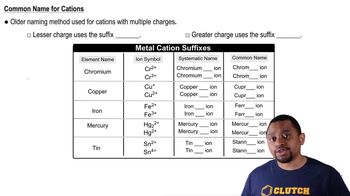
A traditional naming method for metal ions with multiple charges, often using Latin roots and specific suffixes.
Suffix
An ending added to a cation's name, such as '-ous' for lower charge and '-ic' for higher charge in the common naming system.
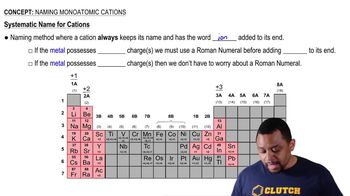
Group 1A
A vertical column in the periodic table containing metals with a fixed +1 charge, not requiring Roman numerals in their names.
Group 2A
A vertical column in the periodic table containing metals with a fixed +2 charge, named without Roman numerals.
Group 3A
A vertical column in the periodic table containing metals with a fixed +3 charge, named without Roman numerals.
Latin Root
The origin of some element symbols and common names, reflecting historical or traditional language influences.
Chromous Ion
A chromium ion with a +2 charge, named using the '-ous' suffix to indicate the lower oxidation state.
Chromic Ion
A chromium ion with a +3 charge, named using the '-ic' suffix to indicate the higher oxidation state.
Cuprous Ion
A copper ion with a +1 charge, named with the '-ous' suffix and derived from the Latin root for copper.
Cupric Ion
A copper ion with a +2 charge, named with the '-ic' suffix and based on the Latin root for copper.
Ferrous Ion
An iron ion with a +2 charge, named with the '-ous' suffix and based on the Latin root for iron.
Ferric Ion
An iron ion with a +3 charge, named with the '-ic' suffix and based on the Latin root for iron.
 BackBack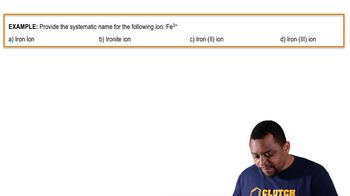
 00:34
00:34