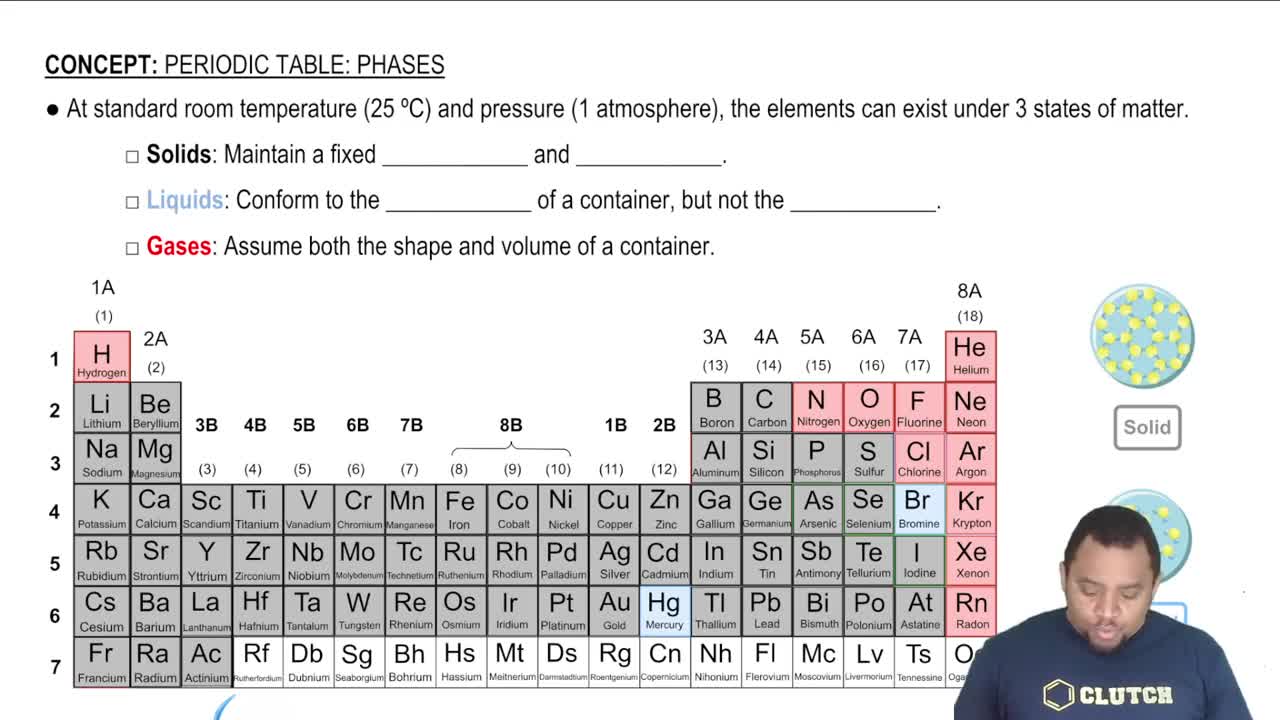
Which elements are liquids at room temperature (25°C and 1 atmosphere)?
Mercury and bromine are the only elements that are liquids at room temperature.
At standard temperature and pressure, which state of matter do most elements on the periodic table exist in?
Most elements on the periodic table exist as solids at standard temperature and pressure.
Which elements are gases at room temperature?
Hydrogen, nitrogen, oxygen, chlorine, and the noble gases are gases at room temperature.
What is the physical state of lithium at room temperature?
Lithium is a solid at room temperature.
Which element is a nonmetal and solid at standard temperature and pressure?
Sulfur is a nonmetal that is solid at standard temperature and pressure.
Why are the elements in the 7th row from Rf to Og not assigned a state of matter at room temperature?
Elements from Rf to Og are synthetic and highly unstable, making their state of matter at room temperature unpredictable.
How do the molecular arrangements differ between solids, liquids, and gases at room temperature?
In solids, molecules are locked in place and maintain a fixed shape and volume; in liquids, molecules are close but move freely, conforming to the shape but not the volume of the container; in gases, molecules are far apart and assume both the shape and volume of the container.
Why can't a liquid always fill the entire volume of its container at room temperature?
A liquid can conform to the shape of its container but cannot fill the entire volume if there is not enough liquid present. This is because liquids do not expand to fill the container like gases do.
Which group on the periodic table contains elements that are all gases at room temperature?
Group 8A, known as the noble gases, contains elements that are all gases at room temperature. Their name reflects their gaseous state under standard conditions.
What property of gases allows them to assume both the shape and volume of their container?
Gases have molecules that are far apart from each other, which enables them to expand and fill both the shape and volume of any container. This distinguishes them from solids and liquids.
 Back
Back
 1:46
1:46