Which isotope is commonly used to date ancient remains, and why is it suitable for this purpose?
Carbon-14 is commonly used to date ancient remains because it is a radioisotope with a suitable half-life that allows scientists to determine the age of organic materials by measuring the amount of carbon-14 remaining.
What does the variable 'n' represent in the formula 0.5^n for radioactive decay?
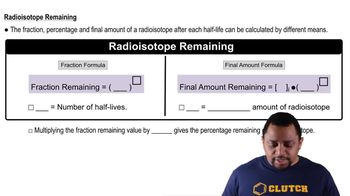
The variable 'n' represents the number of half-lives that have passed. It is used to calculate the fraction of the radioisotope remaining.
How do you calculate the percentage of a radioisotope remaining after a certain number of half-lives?
Multiply the fraction remaining (0.5^n) by 100% to get the percentage remaining. This gives the percent of the original radioisotope still present.
If you start with 100 grams of a radioisotope, what formula would you use to find the amount left after n half-lives?
Use the formula: initial amount times the fraction remaining, or 100 grams × (0.5^n). This gives the final amount of radioisotope remaining.
What happens to the amount of a radioisotope after each half-life passes?
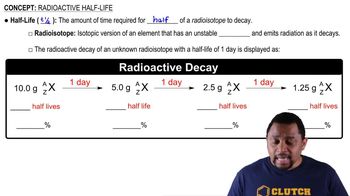
After each half-life, half of the remaining radioisotope decays. This process continues with each subsequent half-life.
How is the mass number and atomic number represented in isotope notation?
In isotope notation, 'x' is the element symbol, 'a' is the mass number, and 'z' is the atomic number. This notation helps identify specific isotopes.
What is the definition of a radioisotope according to the transcript?
A radioisotope is an isotopic version of an element with an unstable nucleus that emits radiation as it decays. This instability leads to radioactive decay over time.
If three half-lives have passed, what fraction of the original radioisotope remains?
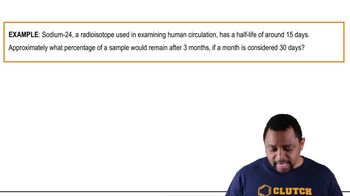
After three half-lives, the fraction remaining is 0.5^3, which equals 0.125. This means 12.5% of the original radioisotope is left.
Why do half-lives vary between different elements?
Half-lives vary because each element's nucleus has a different level of stability. The rate of radioactive decay depends on the specific isotope.
What is the significance of multiplying the fraction remaining by the initial amount in half-life calculations?
Multiplying the fraction remaining by the initial amount gives the actual quantity of radioisotope left. This allows you to determine the mass or number of atoms remaining after decay.