Skip to main content
Introduction to Chemistry
My Course
Learn
Exam Prep
AI Tutor
Study Guides
Flashcards
Explore
Try the app
My Course
Learn
Exam Prep
AI Tutor
Study Guides
Flashcards
Explore
Try the app
Back
States of Matter quiz #1
You can tap to flip the card.
Which state of matter has a definite shape and volume at standard temperature and pressure (STP)?
You can tap to flip the card.
👆
Which state of matter has a definite shape and volume at standard temperature and pressure (STP)?
At STP, solids have a definite shape and volume.
Track progress
Control buttons has been changed to "navigation" mode.
1/10
Related flashcards
Related practice
Recommended videos
States of Matter definitions
States of Matter
13 Terms
States of Matter
3. Matter and Energy
5 problems
Topic
Physical & Chemical Changes
3. Matter and Energy
5 problems
Topic
3. Matter and Energy - Part 1 of 2
12 topics
34 problems
Chapter
3. Matter and Energy - Part 2 of 2
1 topic
3 problems
Chapter
Guided course
01:35
States of Matter Concept 1
6605
views
69
rank
Guided course
01:01
States of Matter Example 1
5725
views
38
rank
1
comments
Guided course
02:23
States of Matter Concept 2
5685
views
43
rank
Terms in this set (10)
Hide definitions
Which state of matter has a definite shape and volume at standard temperature and pressure (STP)?
At STP, solids have a definite shape and volume.
What term describes the ability of a substance to decrease in size when pressure is applied?
This property is called compressibility. Gases are highly compressible, while solids have low compressibility.
How do gas molecules behave inside a container?
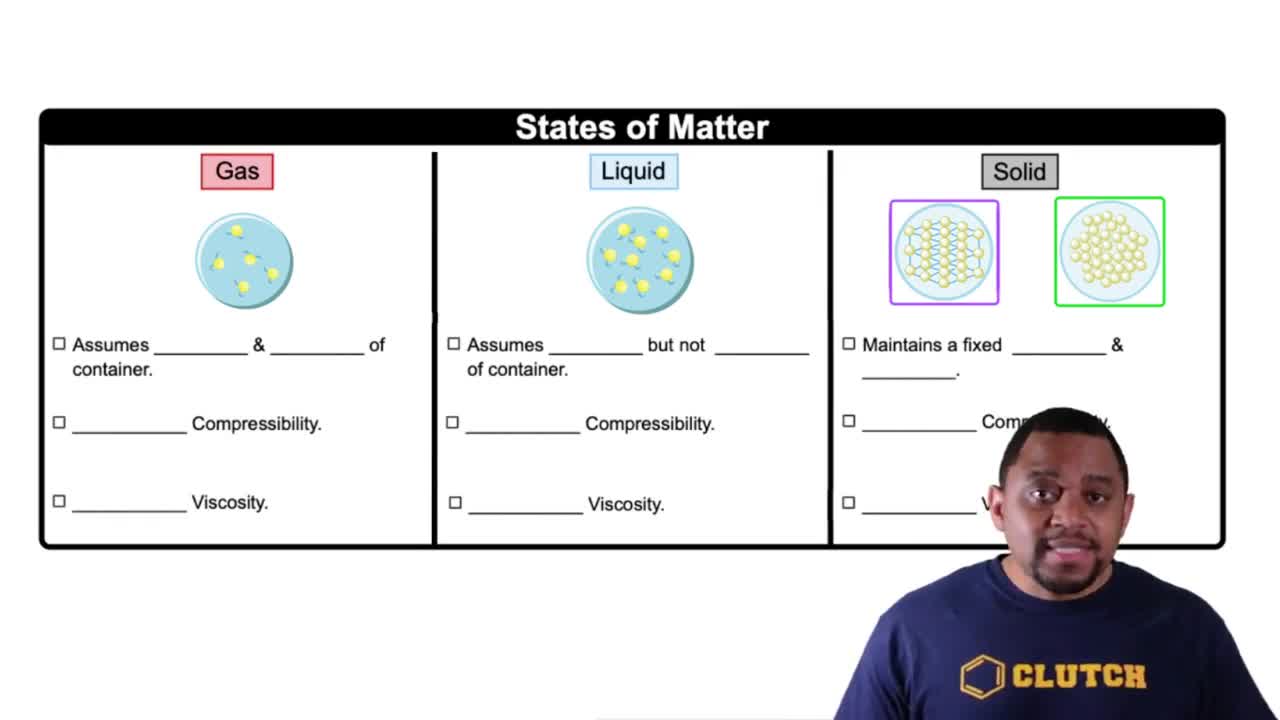
Gas molecules spread out to fill both the shape and volume of their container. They can be compressed by applying pressure.
Why can't a liquid always fill the entire volume of its container?
A liquid can only fill the volume equal to the amount present. If there is less liquid than the container's volume, it won't fill the whole space.
What is viscosity and how does it affect the movement of substances?
Viscosity is the resistance to flow or change in shape. Substances with high viscosity move slowly, while those with low viscosity move quickly.
Which state of matter has molecules locked tightly in place?
Solids have molecules that are locked in place and do not move freely. This results in low compressibility and high viscosity.
How does the viscosity of honey compare to that of water?
Honey has a higher viscosity than water, so it flows more slowly. Water has low viscosity and moves easily.
What happens to gas molecules when pressure is applied to their container?
The gas molecules are squeezed closer together, reducing the volume. This demonstrates the high compressibility of gases.
How do solids respond to applied force in terms of movement?
Solids resist movement unless force is applied due to their high viscosity. They do not flow easily like liquids or gases.
Which state of matter has moderate compressibility and viscosity?
Liquids have moderate compressibility and moderate viscosity. Their molecules move freely but are not as far apart as those in gases.
 BackBack
 01:35
01:35