What are the main steps of the scientific method as used in chemistry?
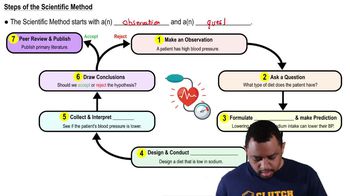
The main steps of the scientific method are: making an observation, asking a question, formulating a hypothesis, designing and conducting an experiment, collecting and interpreting data, drawing conclusions, and reviewing and publishing results.
How do a hypothesis, theory, and law differ in the scientific method?
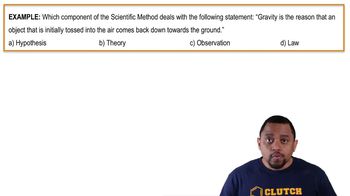
A hypothesis is a proposed and testable explanation for an observation. A theory is a broad, testable hypothesis supported by evidence. A law is a testable phenomenon that has been proven to be true by the scientific community.
Can hypotheses and theories be proven correct in science?
No, hypotheses and theories cannot be proven correct; they can only be falsified or supported by evidence.
What is the role of observation in the scientific method?
Observation is the initial step in the scientific method, involving the collection of information from a primary source, which leads to forming questions and hypotheses.
What is the difference between a qualitative and a quantitative observation in the scientific method?
A qualitative observation describes characteristics without using numbers, while a quantitative observation involves measurements or numerical values.
What happens if an experiment's results do not support the original hypothesis?
If the results do not support the hypothesis, the hypothesis is rejected and the process begins again with a new observation and question.
Why is peer review and publication important in the final step of the scientific method?
Peer review and publication allow other scientists to evaluate, validate, and build upon the findings, ensuring the reliability of the results.
How does the scientific method use predictions in the process of testing a hypothesis?
Predictions are made based on the hypothesis and are tested through experiments to see if the expected outcome occurs.
What role do instruments play in making observations during the scientific method?
Instruments can be used to collect information that may not be detectable by human senses, allowing for more precise and accurate observations.
What is the purpose of collecting and interpreting data in the scientific method?
Collecting and interpreting data helps determine whether the experimental results support or refute the hypothesis.
What is the crucial element of a good hypothesis in the scientific method?
A good hypothesis must be proposed as a testable explanation for an observation, meaning it can be evaluated through experimentation and potentially falsified.
 Back
Back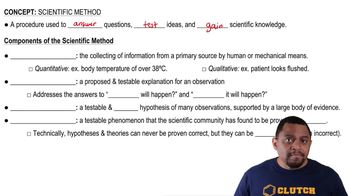
 01:59
01:59