Which radioactive element has the lowest atomic number?
The radioactive element with the lowest atomic number is hydrogen, specifically the isotope tritium (hydrogen-3), which is radioactive.
What does it mean when an atom has decayed in the context of nuclear reactions?
When an atom has decayed in a nuclear reaction, it means the nucleus has emitted a radioactive particle (such as an alpha, beta, or gamma particle), resulting in a change in the number of protons and transforming the atom into a different element.
What subatomic particles are found in the nucleus of an atom?
The nucleus contains protons, which are positively charged, and neutrons, which are neutral. Electrons are found outside the nucleus.
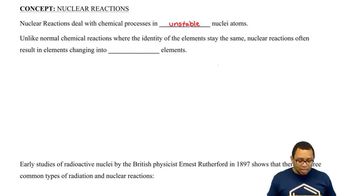
How does a nuclear reaction differ from a regular chemical reaction in terms of element identity?
A nuclear reaction changes the number of protons in the nucleus, resulting in a new element. In contrast, a chemical reaction does not alter the element's identity.
Who was element 104 named after and why?
Element 104 was named Rutherfordium in honor of Ernest Rutherford. He made significant contributions to the field of nuclear chemistry.
What does the term 'emission' indicate about the radioactive particle in a nuclear reaction?
Emission means the radioactive particle is a product of the reaction. It is released from the nucleus during the process.
What is the opposite of 'decay' or 'emission' in nuclear reactions?
The opposite is 'capture,' which means the radioactive particle is a reactant. It is absorbed into the nucleus during the reaction.
Which three major types of nuclear reactions did Rutherford categorize?
Rutherford categorized alpha decay (emission), beta decay (emission), and gamma emission. These are the primary types discussed initially in nuclear chemistry.
What happens to the atomic number of an element during a nuclear reaction?
The atomic number changes because the number of protons in the nucleus is altered. This change results in the formation of a different element.
What additional types of nuclear reactions are mentioned beyond alpha, beta, and gamma processes?
Positron emission and electron capture are additional types of nuclear reactions. These will be discussed further in the course.
 Back
Back
 03:27
03:27