 Back
BackIntroduction to Chemistry - Key Concepts
 01:59
01:59
Terms in this set (20)
Chemistry is the science that seeks to understand what matter does by studying what atoms and molecules do.
Atoms are very small particles that compose all matter, and molecules are groups of atoms bound together by chemical bonds.
A water molecule consists of three atoms: one oxygen and two hydrogen atoms bonded together in a bent shape.
The characteristics of water molecules, including their shape and bonding, make water a liquid at room temperature.
Virtually everything we can hold or touch is made of chemicals, including air, water, toothpaste, and many everyday items.
Chemistry explains properties and behavior of substances by understanding the molecules that compose them.
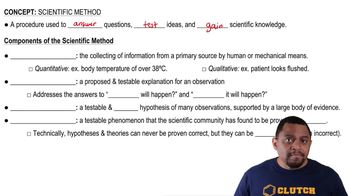
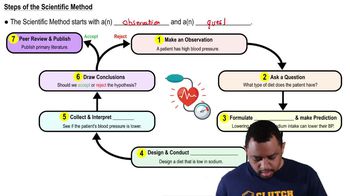
The scientific method is a way of learning that emphasizes observation and experimentation to produce knowledge based on the senses.
The scientific method relies on observation and experimentation, unlike ancient philosophies that emphasized reason and thought alone.
Hypotheses are tentative interpretations or explanations of observations that must be tested by experiments.
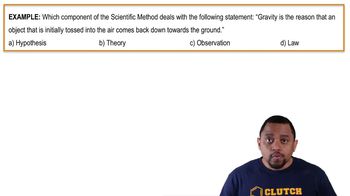
A law is a brief statement that summarizes many observations and predicts future ones.
A theory is a well-established model that explains observations and laws, often predicting behavior beyond them.
Lavoisier observed that the mass of a closed container and its contents does not change during combustion.
The law states that in a chemical reaction, matter is neither created nor destroyed.
Hypotheses are tested by controlled experiments that confirm or invalidate them, leading to revision if necessary.
The theory must be revised or discarded, and new experiments are conducted to test the revisions.
Dalton proposed that all matter is composed of small, indestructible particles called atoms, explaining the conservation of mass.
Well-tested theories are the most powerful scientific knowledge and are as close to truth as science can get.
Two hundred years of experimental evidence and modern imaging technologies support the idea that matter is made of atoms.
Quantification allows precise measurement and comparison of properties, which is essential for scientific observation.
A series of measurements, called data, can be graphed to reveal relationships and support scientific conclusions.