 Back
BackIntroduction to Chemistry Key Concepts
 01:59
01:59
Terms in this set (26)
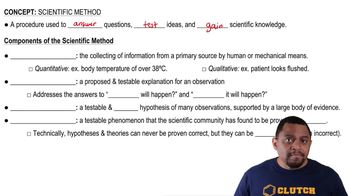
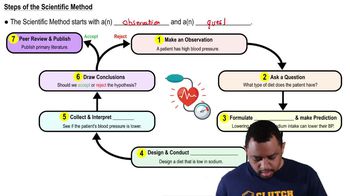
An observation is noting or recording a phenomenon, such as "It rains when clouds are dark." It involves collecting data without explanation.
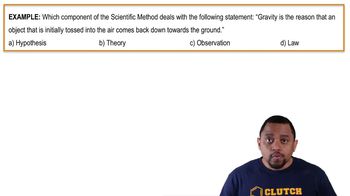
A hypothesis is a proposed explanation or idea that can be tested, for example, "Dark clouds cause rain."
Experimentation involves testing a hypothesis by controlled observation, such as recording when rain occurs after observing clouds.
No, a hypothesis can only be supported or falsified; it cannot be proven absolutely correct.
A hypothesis is a proposed idea, while a theory is a well-supported explanation accepted due to extensive evidence.
Laws describe what happens, while theories explain why it happens; both are equally correct.
Matter is anything that has mass and takes up volume.
Atoms and molecules are the fundamental building blocks of the universe.
Solids have a fixed shape and volume; they do not take the shape or volume of their container.
Gases take the shape and volume of their container and are compressible.
Liquids take the shape but not the volume of their container.
Gas molecules fly around freely and collide occasionally.
Solid molecules vibrate around fixed positions.
Liquid molecules roll or slide around one another.
Gas is the highest energy phase.
Solid is the lowest energy phase.
Solid phase is most likely at low temperatures due to low energy.
An element is a pure substance made of one type of atom, like copper (Cu) or gold (Au).
A compound is a substance made of two or more elements chemically combined, like salt (NaCl).
A homogeneous mixture has uniform composition throughout, like air or seawater.
A heterogeneous mixture has visibly different components, like Italian salad dressing or chicken noodle soup.
A physical change alters the form but not the chemical composition, e.g., melting ice or dissolving sugar.
A chemical change results in new substances, e.g., burning wood, rusting iron, or cooking an egg.
Mass is conserved; the total mass of reactants equals the total mass of products.
Water mass formed is 10.0 g (5.0 g H + 5.0 g O), conserving mass.
Total mass reactants = 266 g; water mass = 266 g - 176 g = 90 g.