 Indietro
Acid-Base Reactions, Titrations, and Buffers: Study Notes for Anatomy & Physiology Students
Guida di studio - Note intelligenti
 Appunti personalizzati basati sui tuoi materiali, ampliati con definizioni chiave, esempi e contesto.
Reactions Between Acids and Bases
Introduction to Acid-Base Reactions
Acid-base reactions are fundamental chemical processes where acids and bases interact to form water and a salt. These reactions are essential for understanding physiological processes such as blood pH regulation and digestion.
Acid: A substance that donates protons (H+).
Base: A substance that accepts protons or donates hydroxide ions (OH-).
Neutralization: The reaction between an acid and a base to produce water and a salt.
Example:
Titration: Determining Concentration
Definition and Procedure
Titration is a laboratory method used to determine the concentration of an unknown solution (analyte) by reacting it with a solution of known concentration (titrant). The process is monitored using an indicator that changes color at the endpoint.
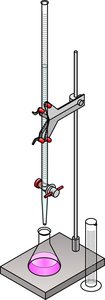
A known volume of analyte is placed in a flask.
The titrant is added from a buret until the reaction reaches the endpoint, indicated by a color change.
The volume of titrant used is recorded to calculate the analyte's concentration.
Endpoint and Equivalence Point
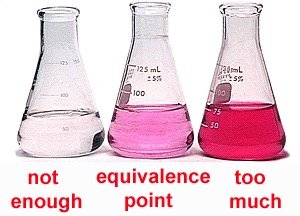
The endpoint is the stage in titration where the indicator changes color, signaling that the reaction is complete. The equivalence point is when stoichiometrically equivalent amounts of acid and base have reacted.
Titration Curves
Understanding Titration Curves
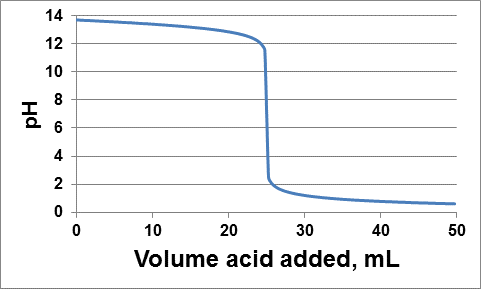
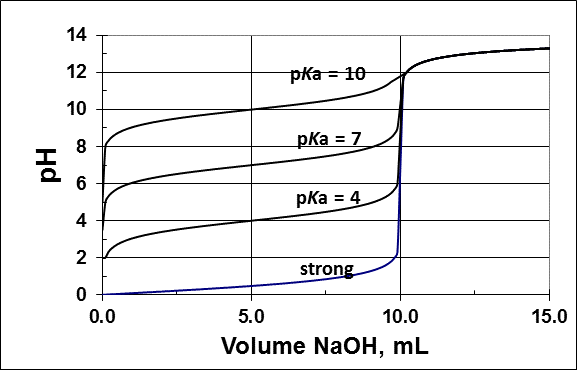
A titration curve is a graph of pH versus the volume of titrant added. It helps visualize the progress of the reaction and identify the equivalence point.
For strong acid-strong base titrations, the pH rises sharply at the equivalence point (pH = 7).
Before the equivalence point, the solution is acidic; after, it becomes basic.
Comparing Titration Curves
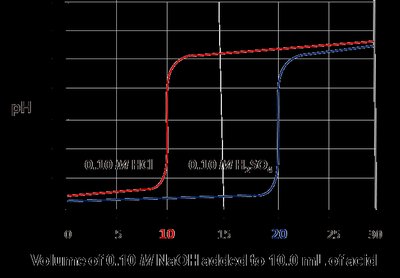
Titration curves differ based on the strength of acids and bases involved. Polyprotic acids and weak acids show multiple or less steep inflection points.
Calculations in Titration
Millimoles and Molarity
Calculations often use millimoles (mmol) for convenience. Molarity (M) is moles per liter, and:
At equivalence: (adjusted for stoichiometry)
Equivalence Point Volume Calculation
To find the volume of titrant needed to reach the equivalence point:
Set up the stoichiometric equation for the reaction.
Calculate mmol of analyte and titrant.
Solve for the unknown volume using (for 1:1 reactions).
Buffer Solutions
Definition and Function
A buffer is a solution that resists changes in pH when small amounts of acid or base are added. Buffers are crucial in physiological systems, such as blood, to maintain stable pH.
Composed of a weak acid and its conjugate base, or a weak base and its conjugate acid.
Examples: HF/F-, NH3/NH4+
Buffer Calculations: Henderson-Hasselbalch Equation
The pH of a buffer can be calculated using the Henderson-Hasselbalch equation:
Where and are the concentrations of the conjugate base and acid, respectively.
Titration of Weak Acids and Bases
Regions of the Titration Curve
The titration of a weak acid with a strong base (or vice versa) can be divided into regions:
Before base is added: Solution is a weak acid; use and an ICE table to find pH.
Before equivalence point: Buffer region; use Henderson-Hasselbalch equation.
At equivalence point: All acid converted to conjugate base; use to find pH.
After equivalence point: Excess strong base determines pH.
Indicators in Titration
Choosing an Indicator
An indicator is a weak acid or base that changes color at a specific pH range. The choice of indicator depends on the expected pH at the equivalence point.
Common indicators: methyl orange, methyl red, bromthymol blue, phenolphthalein.
Choose an indicator whose color change range includes the equivalence point pH.
Polyprotic Acids and Amphoteric Species
Polyprotic Acids
Polyprotic acids can donate more than one proton, ionizing in steps with separate values for each step. Example: H2CO3 (carbonic acid).
Step 1:
Step 2:
Amphoteric Species
An amphoteric species can act as both an acid and a base. Example: hydrogen carbonate ion (HCO3-).
As an acid:
As a base:
If , the solution is weakly basic.
pH and Solubility of Salts
Effect of pH on Solubility
The solubility of salts containing weak base anions (e.g., F-, CH3COO-, CO32-) increases as pH decreases (more acidic). This is explained by Le Chatelier's principle.
Adding acid removes the anion by converting it to the weak acid, shifting equilibrium to dissolve more salt.
Example:
Adding acid:
