 Indietro
Adaptive Immune System: Innate and Adaptive Body Defenses
Guida di studio - Note intelligenti
 Appunti personalizzati basati sui tuoi materiali, ampliati con definizioni chiave, esempi e contesto.
Adaptive Immune System
Overview of Adaptive Defenses
The adaptive immune system is a highly specific defense mechanism that eliminates pathogens and abnormal cells. It amplifies inflammatory responses and activates complement proteins, but requires priming by exposure to a specific foreign substance, which takes time.
Specificity: Targets specific antigens.
Systemic: Functions throughout the body, not just at the site of infection.
Memory: Responds more vigorously to previously encountered antigens.
Main Branches:
Humoral (antibody-mediated) immunity
Cellular (cell-mediated) immunity
Humoral Immunity
Mechanism and Targets
Humoral immunity involves antibodies produced by lymphocytes that circulate in body fluids. These antibodies bind to target cells, temporarily inactivate them, and mark them for destruction by phagocytes or complement proteins. Humoral immunity primarily targets extracellular pathogens.
Cellular Immunity
Mechanism and Targets
Cellular immunity is mediated by lymphocytes that act directly or indirectly against target cells. Direct action involves killing infected cells, while indirect action involves releasing chemicals to enhance inflammation or activate other immune cells. Cellular immunity targets intracellular pathogens and abnormal cells.
Antigens
Definition and Characteristics
Antigens are substances that mobilize adaptive defenses and provoke an immune response. Most antigens are large, complex molecules not normally found in the body (nonself).
Complete Antigens: Have immunogenicity (stimulate lymphocyte proliferation) and reactivity (react with lymphocytes and antibodies).
Haptens (Incomplete Antigens): Small molecules that are not immunogenic unless attached to body proteins, potentially causing harmful immune responses.
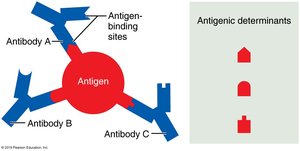
Antigenic Determinants: Specific parts of an antigen that antibodies or lymphocyte receptors bind to. Most antigens have multiple determinants, mobilizing various lymphocyte populations and antibody types.
Self-Antigens: MHC Proteins
Self-antigens are proteins on cell surfaces that are not antigenic to self but may be antigenic to others. MHC proteins (major histocompatibility complex) are unique glycoproteins that present antigens to T lymphocytes, enabling immune recognition.
Lymphocytes and Antigen-Presenting Cells
Types of Cells
B lymphocytes (B cells): Mediate humoral immunity.
T lymphocytes (T cells): Mediate cellular immunity.
Antigen-presenting cells (APCs): Include dendritic cells, macrophages, and B cells; they present antigens to T cells and play auxiliary roles in immunity.
Lymphocyte Development, Maturation, and Activation
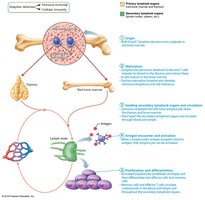
Lymphocytes undergo a five-step process:
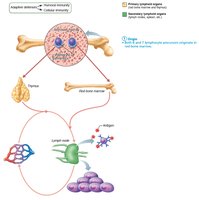
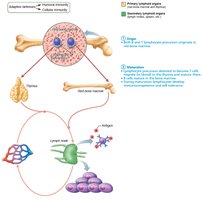
Origin: Both B and T lymphocytes originate in red bone marrow.
Maturation: Lymphocytes mature in primary lymphoid organs (B cells in bone marrow, T cells in thymus) and are educated for immunocompetence (recognize one specific antigen) and self-tolerance (unresponsive to own antigens).
Seeding Secondary Lymphoid Organs: Immunocompetent but naive lymphocytes are exported to secondary lymphoid organs (lymph nodes, spleen) to increase the chance of antigen encounter.
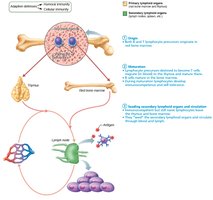
Antigen Encounter and Activation: First encounter with antigen triggers clonal selection and differentiation into active cells.
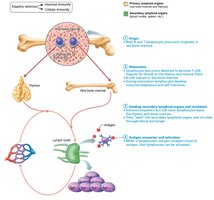
Proliferation and Differentiation: Activated lymphocytes proliferate, forming clones. Most become effector cells; some become memory cells for rapid future responses.
Lymphocyte Education
Positive Selection: Selects T cells capable of recognizing self-MHC proteins.
Negative Selection: Eliminates T cells that bind to self-antigens, ensuring self-tolerance (clonal deletion).
Antigen-Presenting Cells (APCs)
Dendritic Cells: Found in connective tissues and epidermis; act as sentinels, phagocytize pathogens, and present antigens to T cells in lymph nodes. Key link between innate and adaptive immunity.
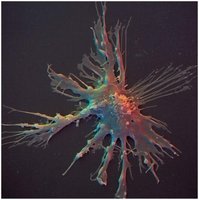
Macrophages: Widely distributed; present antigens to T cells, activating both T cells and themselves, triggering inflammation and recruiting defenses.
B Lymphocytes: Present antigens to helper T cells to assist their own activation.
Overview of B and T Lymphocytes
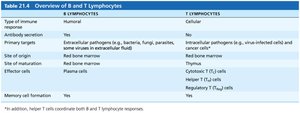
The following table summarizes the differences between B and T lymphocytes:
B Lymphocytes | T Lymphocytes | |
|---|---|---|
Type of immune response | Humoral | Cellular |
Antibody secretion | Yes | No |
Primary targets | Extracellular pathogens (bacteria, fungi, parasites, some viruses in extracellular fluid) | Intracellular pathogens (virus-infected cells, cancer cells) |
Site of maturation | Red bone marrow | Thymus |
Effector cells | Plasma cells | Cytotoxic T cells, Helper T cells, Regulatory T cells |
Memory cell formation | Yes | Yes |
Humoral Immune Response
Activation and Differentiation of B Cells
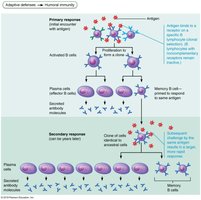
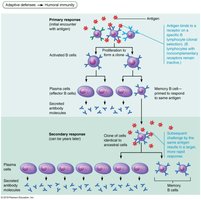
B cells are activated when antigens bind to surface receptors, triggering receptor-mediated endocytosis and clonal selection. This leads to proliferation and differentiation into plasma cells (antibody-secreting effector cells) and memory cells.
Immunological Memory
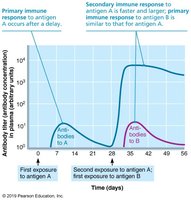
Primary Immune Response: Occurs upon first exposure to antigen; lag period of 3-6 days, peak antibody levels in 10 days, then decline.
Secondary Immune Response: Faster, more prolonged, and more effective upon re-exposure; antibody levels peak in 2-3 days and remain high for weeks to months.
Active and Passive Humoral Immunity
Types of Humoral Immunity
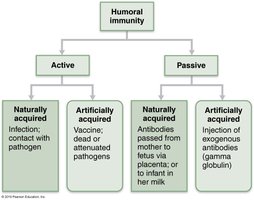
Active Humoral Immunity: B cells encounter antigens and produce antibodies.
Naturally acquired: Response to infection.
Artificially acquired: Response to vaccination.
Passive Humoral Immunity: Ready-made antibodies are introduced.
Naturally acquired: Antibodies delivered to fetus via placenta or to infant through milk.
Artificially acquired: Injection of serum (e.g., gamma globulin).
Antibodies (Immunoglobulins)
Structure and Classes
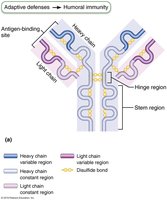
Antibodies are proteins secreted by plasma cells, capable of binding specifically with antigens. They are grouped into five classes: IgM, IgA, IgD, IgG, and IgE.
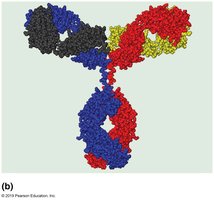
Basic Structure: T- or Y-shaped monomer with four polypeptide chains (two heavy, two light), linked by disulfide bonds. Variable regions form antigen-binding sites; constant regions determine antibody class and function.
Antibody Functions
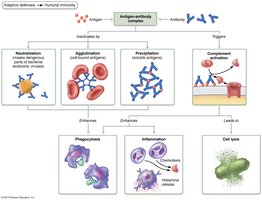
Neutralization: Antibodies block specific sites on pathogens, preventing their binding to tissue cells.
Agglutination: Antibodies cross-link antigens, forming clumps (e.g., mismatched blood cells).
Precipitation: Antigen-antibody complexes precipitate out of solution, facilitating phagocytosis.
Complement Fixation: Antibodies trigger complement activation, leading to cell lysis and amplification of inflammatory response.
Summary of Antibody Actions
Antigen-antibody complexes do not destroy antigens directly; they prepare them for destruction by innate defenses.
Additional info:
Gene recombination in lymphocytes allows for immense diversity in antigen receptors, enabling recognition of a vast array of pathogens.
Memory cells are crucial for rapid and effective secondary immune responses, forming the basis for vaccination strategies.
