 Indietro
Anatomy & Physiology Foundations in Pilates: Mini-Textbook Study Notes
Guida di studio - Note intelligenti
 Appunti personalizzati basati sui tuoi materiali, ampliati con definizioni chiave, esempi e contesto.
SIX KEY PRINCIPLES OF PILATES
Foundation Principles
Pilates is a comprehensive system of physical and mental conditioning that enhances strength, flexibility, coordination, and well-being. The method is built on six foundational principles:
Breath: Central to Pilates, breath acts as the fuel for movement and is essential for life. Understanding respiratory anatomy enhances the use of breath in exercise.
Concentration: Focused attention on each movement and muscle group is required for mastery and safety.
Center: Refers to the body's core or 'powerhouse,' the source of stability and energy for all movement.
Control: Regulation and refinement of movement, leading to improved coordination and reduced injury risk.
Precision: Exactness in movement execution, supported by anatomical knowledge, maximizes effectiveness and safety.
Flow: Smooth, continuous movement that integrates all principles, enhancing performance and enjoyment.
These principles are both physical and mental, connecting body and mind for optimal movement and health.
A CLOSER LOOK AT THE SCIENCE OF BREATHING
Anatomy of the Respiratory System
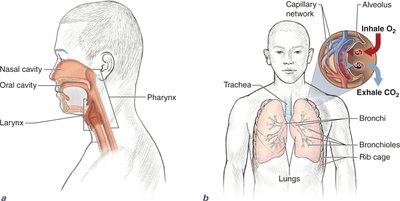
The respiratory system delivers oxygen and removes carbon dioxide from the body. It is divided into:
Upper respiratory tract: Nasal cavity, oral cavity, pharynx, larynx – purifies, warms, and humidifies air.
Lower respiratory tract: Trachea, bronchi, bronchioles, alveoli – site of gas exchange.
Alveoli are tiny air sacs with thin walls, allowing efficient gas exchange with pulmonary capillaries.
Mechanics of Breathing
Inhalation (Inspiration): Diaphragm contracts and flattens, external intercostals lift the rib cage, increasing thoracic volume and decreasing intrapulmonary pressure, drawing air in.
Exhalation (Expiration): Primarily passive; diaphragm and intercostals relax, thoracic volume decreases, pressure increases, and air is expelled. Forced exhalation recruits abdominal and internal intercostal muscles.
Breathing in Pilates
Lateral Breathing: Emphasizes rib cage expansion with abdominal contraction, supporting core stability during movement.
Set Breath Patterns: Specific inhale/exhale sequences prevent breath-holding and excessive tension.
Active Breathing: Percussive, forceful exhalation and inhalation to activate core muscles and enhance exercise dynamics.
SPINE, CORE, AND BODY ALIGNMENT
The Skeleton and Spine
The human skeleton consists of 206 bones, divided into:
Axial skeleton: Skull, vertebral column, ribs, sternum.
Appendicular skeleton: Limbs and girdles.
The spine is composed of 33 vertebrae in five regions: cervical, thoracic, lumbar, sacral (fused), and coccygeal (tailbone). Each region has characteristic curves that aid movement and shock absorption.
Joints and Movements of the Spine
Intervertebral discs: Cartilaginous joints for shock absorption.
Facet joints: Allow gliding movements; orientation affects range of motion.
Movements: Flexion, extension, lateral flexion, rotation.
Primary Muscles of the Spine
Abdominals: Rectus abdominis, external/internal obliques, transversus abdominis – flexion, rotation, stabilization.
Spinal extensors: Erector spinae (spinalis, longissimus, iliocostalis), semispinalis, deep posterior group (multifidus, rotatores, interspinales, intertransversales) – extension, stabilization.
Quadratus lumborum: Lateral flexion, lumbar stability.
Iliopsoas: Hip flexion, lumbar stabilization.
The Powerhouse (Core)
The powerhouse/core includes the abdomen, lower back, and pelvis. Core stability is the neuromuscular control that maintains pelvic and spinal alignment during movement. Key muscles: abdominals, spinal extensors, gluteus maximus, pelvic floor muscles.
MUSCLES, MOVEMENT ANALYSIS, AND MAT WORK
Types of Joints and Movements
Fibrous joints: Immovable (e.g., skull sutures).
Cartilaginous joints: Slightly movable (e.g., intervertebral discs).
Synovial joints: Freely movable (e.g., ball-and-socket, hinge).
Movements: flexion/extension, abduction/adduction, internal/external rotation, specialized movements (e.g., dorsiflexion/plantar flexion).
Muscle Actions and Roles
Agonist (mover): Prime muscle producing movement.
Antagonist: Opposes the agonist.
Synergist: Assists the agonist, neutralizes unwanted actions.
Stabilizer: Supports a body part during movement.
Force couple: Muscles on opposite sides of a joint working together (e.g., abdominals and hamstrings for posterior pelvic tilt).
Types of Muscle Contraction
Concentric: Muscle shortens (e.g., up phase of a curl-up).
Eccentric: Muscle lengthens (e.g., down phase of a curl-up).
Isometric: Muscle contracts without changing length (e.g., holding a plank).
APPLICATION: PILATES EXERCISE EXAMPLE
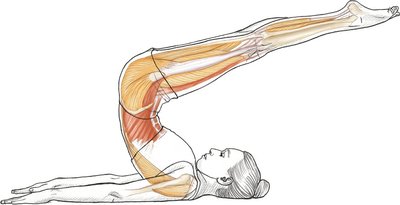
Rollover With Legs Spread
This advanced Pilates exercise demonstrates spinal flexion, core stabilization, and dynamic flexibility. The abdominals and hip flexors are key movers, while the spinal extensors and hip extensors provide stabilization and control during the movement.
ANATOMY OF THE RESPIRATORY SYSTEM (VISUAL)
The following image illustrates the upper and lower respiratory tracts, including the nasal and oral cavities, pharynx, larynx, trachea, bronchi, bronchioles, alveoli, and the process of gas exchange in the alveolus.
SUMMARY TABLE: SPINAL MOVEMENTS AND MUSCLES
Joint Movement | Primary Muscles | Secondary Muscles |
|---|---|---|
Spinal flexion | Rectus abdominis, External oblique, Internal oblique | None |
Spinal extension | Erector spinae (spinalis, longissimus, iliocostalis), Semispinalis | Deep posterior spinal group (interspinales, intertransversales, rotatores, multifidus) |
Spinal lateral flexion | External oblique (same side), Internal oblique (same side), Quadratus lumborum (same side), Erector spinae (same side) | Semispinalis (same side), Deep posterior spinal group (same side), Rectus abdominis (same side), Iliopsoas (lumbar region, same side) |
Spinal rotation | External oblique (opposite side), Internal oblique (same side), Erector spinae (same side) | Semispinalis (opposite side), Deep posterior spinal group (opposite side) |
CONCLUSION
Pilates integrates foundational principles of anatomy and physiology, emphasizing the importance of breath, core stability, precise movement, and flow. Understanding the structure and function of the musculoskeletal and respiratory systems enhances both the safety and effectiveness of Pilates practice. Mastery of these concepts supports lifelong health, injury prevention, and optimal physical performance.
