 Indietro
Anatomy & Physiology Unit 1 Exam Study Guide – Step-by-Step Guidance
Guida di studio - Note intelligenti
 Appunti personalizzati basati sui tuoi materiali, ampliati con definizioni chiave, esempi e contesto.
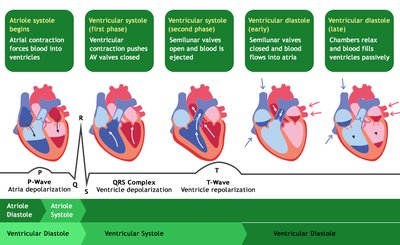
Q11. What are the four phases of the cardiac cycle and their events?
Background
Topic: Cardiac Cycle
This question tests your understanding of the sequence of events that occur during one heartbeat, including the contraction and relaxation of the atria and ventricles, and the associated changes in blood flow and valve positions.
Key Terms:
Systole: Contraction phase of the heart chambers.
Diastole: Relaxation phase of the heart chambers.
AV valves: Valves between atria and ventricles (tricuspid and mitral).
Semilunar valves: Valves at the base of the aorta and pulmonary artery.
Key Concepts:
The cardiac cycle consists of alternating periods of systole and diastole for both atria and ventricles.
Blood flow is regulated by the opening and closing of heart valves in response to pressure changes.
Step-by-Step Guidance
Identify the first phase: Atrial systole, where the atria contract and push blood into the ventricles. AV valves are open, semilunar valves are closed.
Next, recognize ventricular systole (first phase): Ventricles begin to contract, AV valves close to prevent backflow, but semilunar valves are still closed.
Then, ventricular systole (second phase): Pressure rises, semilunar valves open, and blood is ejected into the arteries.
After ejection, ventricular diastole begins: Semilunar valves close, ventricles relax, and blood flows into the atria. AV valves open as pressure drops.
Finally, late ventricular diastole: Chambers relax fully, and blood fills the ventricles passively from the atria.
Try solving on your own before revealing the answer!
Final Answer:
The four phases of the cardiac cycle are:
Atrial systole: Atria contract, AV valves open, blood moves into ventricles.
Ventricular systole (isovolumetric contraction): Ventricles contract, AV valves close, semilunar valves still closed.
Ventricular systole (ventricular ejection): Semilunar valves open, blood is ejected into arteries.
Ventricular diastole: Semilunar valves close, ventricles relax, AV valves open, blood flows passively into ventricles.
These phases ensure efficient blood flow through the heart and are coordinated with the opening and closing of heart valves.
Q12. Describe the pulmonary and systemic blood circulation.
Background
Topic: Circulatory System
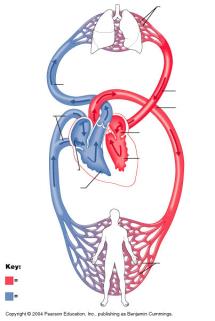
This question tests your knowledge of the two main circuits of blood flow in the body: pulmonary circulation (between heart and lungs) and systemic circulation (between heart and rest of the body).
Key Terms:
Pulmonary circulation: Carries deoxygenated blood from the right ventricle to the lungs and returns oxygenated blood to the left atrium.
Systemic circulation: Carries oxygenated blood from the left ventricle to the body and returns deoxygenated blood to the right atrium.
Arteries: Vessels carrying blood away from the heart.
Veins: Vessels carrying blood toward the heart.
Key Concepts:
The heart acts as a double pump, sending blood to the lungs for oxygenation and then to the rest of the body for nutrient delivery.
Blood flow direction is determined by pressure gradients and valve positions.
Step-by-Step Guidance
Start with pulmonary circulation: Deoxygenated blood enters the right atrium, moves to the right ventricle, and is pumped through the pulmonary arteries to the lungs.
In the lungs, blood picks up oxygen and releases carbon dioxide.
Oxygenated blood returns to the left atrium via the pulmonary veins.
Systemic circulation begins: Oxygenated blood moves from the left atrium to the left ventricle, then is pumped out through the aorta to the body.
After delivering oxygen and nutrients, deoxygenated blood returns to the right atrium via the systemic veins.
Try solving on your own before revealing the answer!
Final Answer:
Pulmonary circulation carries deoxygenated blood from the right ventricle to the lungs via the pulmonary arteries, where it becomes oxygenated and returns to the left atrium via the pulmonary veins. Systemic circulation carries oxygenated blood from the left ventricle through the aorta to the body, delivering oxygen and nutrients, and returns deoxygenated blood to the right atrium via the systemic veins.
This double circuit ensures that blood is oxygenated before being sent to the tissues and that waste products are removed efficiently.
