 Indietro
Arthritis: Types, Causes, Symptoms, and Treatments
Guida di studio - Note intelligenti
 Appunti personalizzati basati sui tuoi materiali, ampliati con definizioni chiave, esempi e contesto.
Arthritis
Overview of Arthritis
Arthritis is a general term describing inflammation of the joints, often resulting in pain, swelling, and reduced mobility. It is commonly caused by exposure to high compressive forces and excessive wear due to friction within the joint.
Definition: Arthritis refers to joint inflammation, which can arise from mechanical wear or immune-mediated processes.
Main Types: The two primary types are osteoarthritis and rheumatoid arthritis.
Types of Arthritis
Arthritis can be classified based on its underlying cause and clinical presentation. The two most common forms are:
Osteoarthritis: A degenerative joint disease characterized by the breakdown of cartilage covering the ends of bones. This leads to bones rubbing together, causing pain and inflammation.
Rheumatoid Arthritis: An autoimmune disorder in which the immune system attacks the synovial membrane tissue of the joints, resulting in chronic inflammation and often permanent deformity.
Comparison of Normal, Osteoarthritic, and Rheumatoid Arthritic Joints
The following diagram illustrates the structural differences between a normal joint, a joint affected by osteoarthritis, and a joint affected by rheumatoid arthritis:
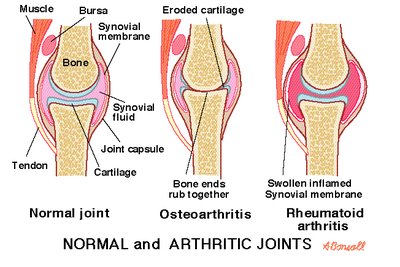
Normal Joint: Features intact cartilage, synovial membrane, and synovial fluid, allowing smooth movement.
Osteoarthritis: Shows eroded cartilage and bone ends rubbing together, leading to pain and inflammation.
Rheumatoid Arthritis: Displays a swollen, inflamed synovial membrane due to immune system attack, often resulting in joint deformity.
Causes of Arthritis
Osteoarthritis: Caused by mechanical wear and tear, aging, and repetitive stress on joints.
Rheumatoid Arthritis: Caused by an autoimmune response where the body’s immune system attacks healthy joint tissues.
Symptoms of Arthritis
Pain: Most common symptom, often worsened by movement.
Inflammation: Swelling and redness around the affected joint.
Reduced Mobility: Stiffness and decreased range of motion.
Deformity: Especially in rheumatoid arthritis, permanent joint deformity may occur.
Treatments for Arthritis
There are a wide range of treatment options for arthritis, tailored to the type and severity of the condition:
Exercise: Helps maintain joint range of motion and flexibility. Activities such as yoga and tai chi are beneficial for stretching.
Medications: Includes painkillers, anti-inflammatory drugs, topical pain blockers, steroid injections, and immunosuppressive drugs for rheumatoid arthritis.
Physical Therapy: Aims to improve joint mobility and strengthen muscles surrounding the affected area.
Surgical Treatments: Options include joint repair, replacement, and fusion procedures.
Alternative Therapies: Acupuncture, massage, and supplements such as glucosamine and chondroitin may help reduce pain.
Summary Table: Osteoarthritis vs. Rheumatoid Arthritis
Feature | Osteoarthritis | Rheumatoid Arthritis |
|---|---|---|
Cause | Wear & tear, aging | Autoimmune attack |
Cartilage | Eroded | Inflamed synovial membrane |
Symptoms | Pain, inflammation | Pain, inflammation, deformity |
Treatment | Pain medications, joint replacement | Medications, rest, surgery |
Key Terms
Cartilage: Flexible connective tissue covering the ends of bones in joints.
Synovial Membrane: Tissue lining the joint capsule, producing synovial fluid for lubrication.
Autoimmune Disorder: Condition in which the immune system attacks the body’s own tissues.
Additional info: Academic context was added to clarify definitions, symptoms, and treatment options, and to provide a comparative table for exam preparation.
