 Indietro
Articulations (Joints): Structure, Classification, and Movements
Guida di studio - Note intelligenti
 Appunti personalizzati basati sui tuoi materiali, ampliati con definizioni chiave, esempi e contesto.
Articulations (Joints)
Introduction to Joints
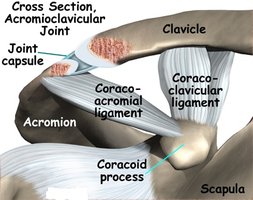
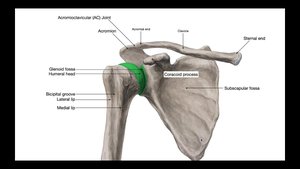
Joints, or articulations, are the anatomical structures that connect bones, enabling the skeletal system to function as a whole. They are the sites where bones meet, and may also involve cartilage or teeth. The scientific study of joints is called arthrology. - Definition: A joint (articulation) is the place of contact between bones, bone and cartilage, or bones and teeth. - Example: The sternoclavicular joint is where the manubrium of the sternum articulates with the sternal end of the clavicle; the glenohumeral joint is where the glenoid cavity of the scapula meets the head of the humerus (shoulder joint). 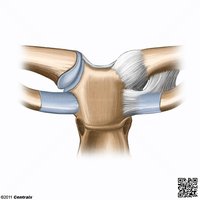
Structural Classification of Joints
Joints are classified based on the material connecting the bones and the presence or absence of a joint cavity. - Fibrous joints: Bones are connected by dense fibrous connective tissue; no joint cavity. - Cartilaginous joints: Bones are connected by cartilage; no joint cavity. - Synovial joints: Bones are separated by a fluid-filled joint cavity and usually covered by hyaline (articular) cartilage. 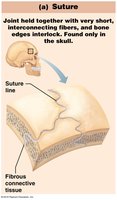
Functional Classification of Joints
Joints are also classified by their degree of mobility: - Synarthrosis: No movement (e.g., sutures of the skull). - Amphiarthrosis: Slight movement (e.g., intervertebral discs). - Diarthrosis: Freely movable (e.g., most synovial joints).
Fibrous Joints
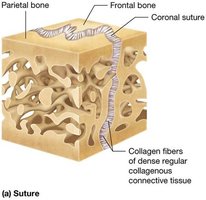
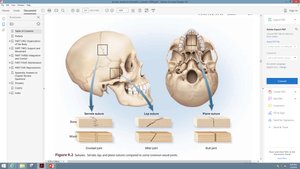
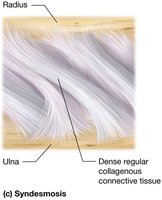
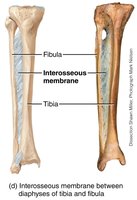
Fibrous joints are united by dense fibrous connective tissue. The amount of movement depends on the length of the connective tissue fibers. - Sutures: Immobile joints found only in the skull. - Syndesmoses: Bones connected by a ligament or interosseous membrane; more movement than sutures. - Gomphoses: "Peg in socket" joints, such as the attachment of a tooth to its socket.
Cartilaginous Joints
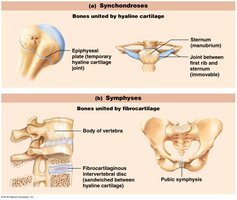
Cartilaginous joints allow limited or no movement. - Synchondroses: Bones bound by hyaline cartilage (e.g., epiphyseal plate). - Symphyses: Bones joined by fibrocartilage (e.g., pubic symphysis, intervertebral discs).
Synovial Joints
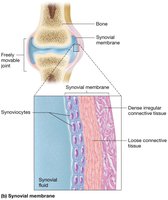
Synovial joints are the most familiar and mobile type of joint, characterized by a joint cavity. - Features: Articular cartilage, joint cavity, synovial fluid, articular capsule, reinforcing ligaments, nerves, and blood vessels. 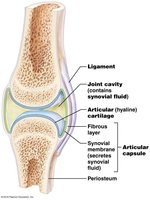
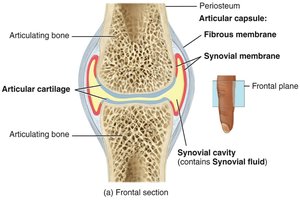
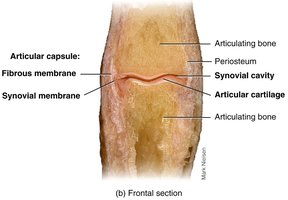
Synovial Fluid
Synovial fluid is a viscous ultrafiltrate of plasma enriched with hyaluronic acid and lubricin. It nourishes articular cartilage, reduces friction, and absorbs shock. - Components: Hyaluronic acid (viscosity), lubricin (friction reduction), albumin (fluid balance).
Accessory Structures of Synovial Joints
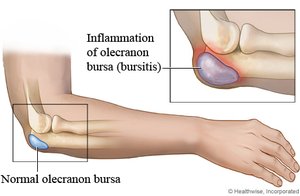
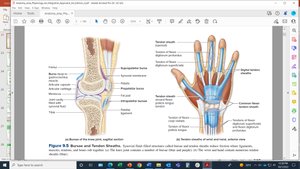
- Tendons: Attach muscle to bone. - Ligaments: Attach bone to bone. - Bursae: Fibrous sacs lined with synovial membrane, filled with synovial fluid; reduce friction and cushion tissues. 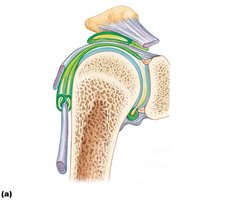
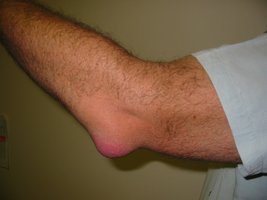
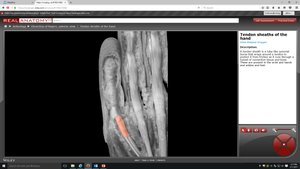
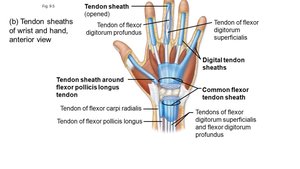
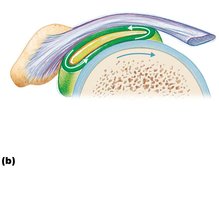 - Tendon Sheaths: Tube-like bursae that wrap around tendons to protect them from friction.
Classes of Synovial Joints
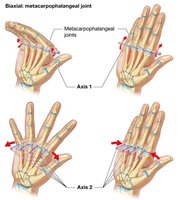
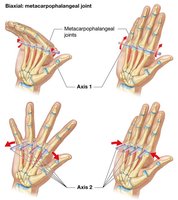
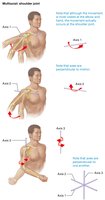
Synovial joints are classified by their patterns of motion, determined by the shapes of the articular surfaces. - Uniaxial: Motion in one plane (e.g., elbow joint). 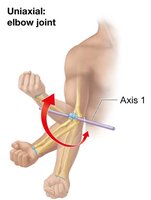 - Biaxial: Motion in two planes (e.g., metacarpophalangeal joint).
 - Multiaxial: Motion in several directions (e.g., shoulder and hip joints).
Types of Synovial Joints
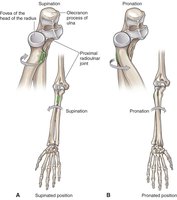
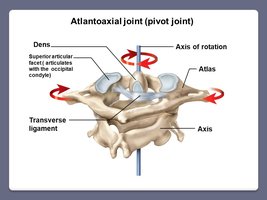
- Plane (Gliding) Joints: Flat surfaces, limited movement (e.g., carpal bones). 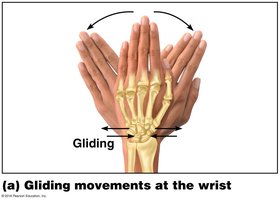 - Hinge Joints: Uniaxial, flexion and extension (e.g., elbow, knee). - Pivot Joints: Uniaxial, rotation (e.g., proximal radioulnar, atlantoaxial).
 - Condylar (Ellipsoid) Joints: Biaxial, oval convex surface fits into concave surface (e.g., wrist, knuckles). - Saddle Joints: Biaxial, articular surfaces are both concave and convex (e.g., thumb CMC joint). - Ball-and-Socket Joints: Multiaxial, spherical head fits into cup-like socket (e.g., shoulder, hip).
Joint Movements
Movement terminology describes how bones move at joints, always relating to the joint's structure and allowed motions. Categories: Gliding, angular, rotation, and special movements.
Gliding Movements
Flat bone surfaces move back and forth or side to side, with limited range. 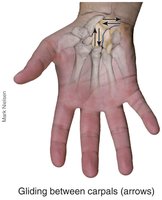
Angular Movements
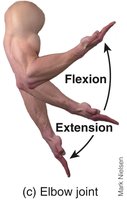
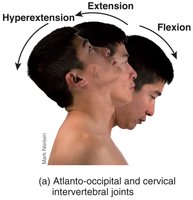
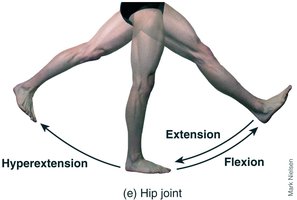
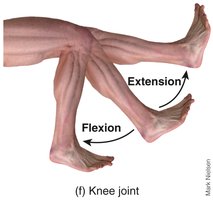
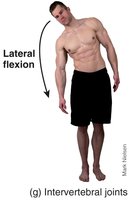
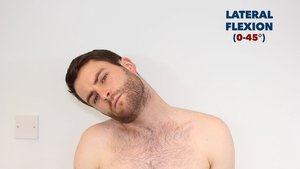
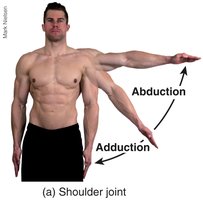
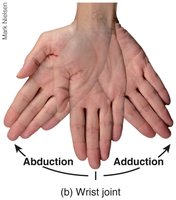
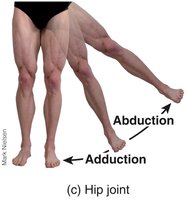
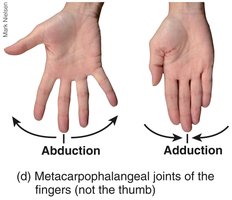
Occur when the angle between articulating bones increases or decreases. - Flexion: Decrease in angle. - Extension: Increase in angle. - Hyperextension: Extension beyond anatomical position. - Abduction: Movement away from midline. - Adduction: Movement toward midline. - Circumduction: Distal end moves in a circle, proximal end stationary. 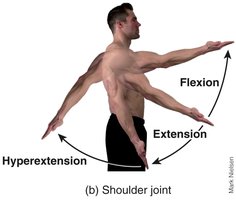
Rotation
Involves a bone revolving around its own longitudinal axis. - Medial rotation: Anterior surface turns toward midline. - Lateral rotation: Anterior surface turns away from midline.
Special Movements
- Elevation: Upward movement. - Depression: Downward movement. - Protraction: Anterior movement in transverse plane. - Retraction: Posterior movement in transverse plane. - Inversion: Soles of feet move medially. - Eversion: Soles of feet move laterally. - Dorsiflexion: Bending foot superiorly at ankle. - Plantar flexion: Bending foot inferiorly at ankle. - Supination: Palm faces anteriorly. - Pronation: Palm faces posteriorly. - Opposition: Thumb touches fingertips.
Levers in the Musculoskeletal System
Most skeletal muscles move using leverage. - Lever: Rigid bar (bone) that moves on a fixed point (fulcrum, joint). - Effort: Force applied by muscle contraction. - Load: Resistance moved by the effort.
Types of Levers
- First-class: Fulcrum between load and effort (e.g., seesaw). - Second-class: Load between fulcrum and effort (e.g., wheelbarrow). - Third-class: Effort between load and fulcrum (e.g., hammer, most joints in the body).
Summary Table: Structural and Functional Classification of Joints
Type | Structural Classification | Functional Classification | Examples |
|---|---|---|---|
Fibrous | Sutures, Syndesmoses, Gomphoses | Synarthrosis, Amphiarthrosis | Skull sutures, distal tibiofibular joint, tooth socket |
Cartilaginous | Synchondroses, Symphyses | Synarthrosis, Amphiarthrosis | Epiphyseal plate, pubic symphysis |
Synovial | Plane, Hinge, Pivot, Condylar, Saddle, Ball-and-Socket | Diarthrosis | Shoulder, hip, elbow, knee, wrist, thumb |
Summary Table: Synovial Joint Movements
Movement | Description | Example Joint |
|---|---|---|
Gliding | Flat surfaces slide past each other | Carpals, tarsals |
Flexion/Extension | Decrease/increase angle between bones | Elbow, knee, hip, shoulder |
Abduction/Adduction | Move away/toward midline | Shoulder, hip, fingers |
Circumduction | Distal end moves in circle | Shoulder, hip |
Rotation | Bone revolves around axis | Atlantoaxial, hip, shoulder |
Special Movements | Elevation, depression, protraction, retraction, inversion, eversion, dorsiflexion, plantar flexion, supination, pronation, opposition | Jaw, ankle, wrist, thumb |
Key Terms
- Arthrology: Scientific study of joints. - Articulation: Site of contact between bones. - Synovial fluid: Lubricating fluid in synovial joints. - Bursa: Fluid-filled sac reducing friction. - Tendon sheath: Protective tube around tendons.
Equations
Mechanical Advantage of a Lever: Range of Motion:
Example Application
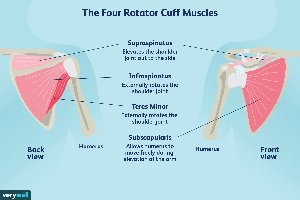
- Shoulder Joint: The glenohumeral joint is a ball-and-socket synovial joint, allowing multiaxial movement but sacrificing stability for mobility. Rotator cuff muscles provide stability. Additional info: Academic context was added to clarify joint types, movement terminology, and lever mechanics.
